.svg&w=384&q=75 "GoalGist logo")
Gornik Zabrze vs Fenerbahçe: Tactical Clash in 1–1 Draw
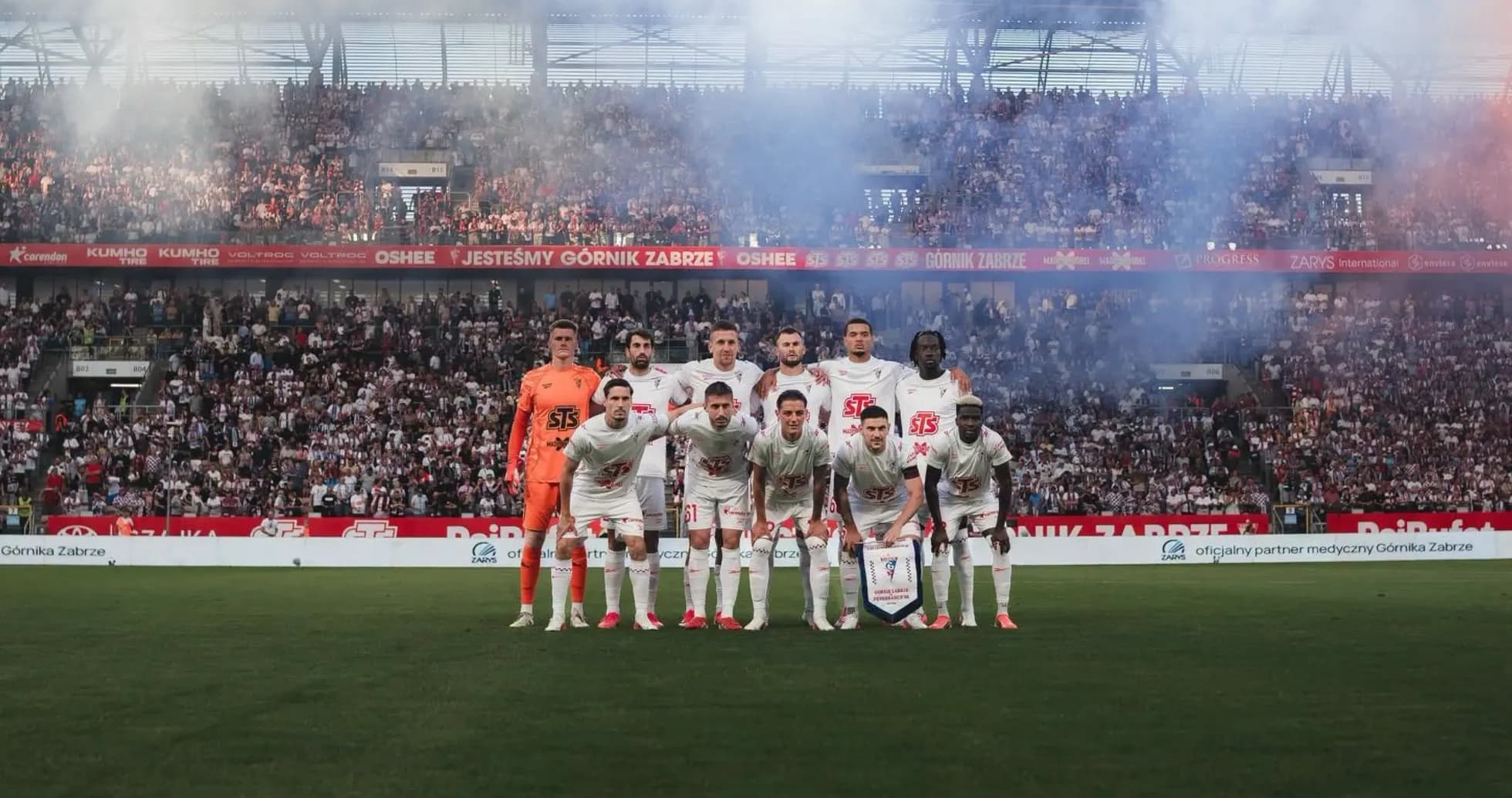
The 1–1 draw at Stadion im. Ernesta Pohla was shaped less by chaos than by two very clear game plans colliding. Gornik Zabrze’s 4-1-4-1 under Michal Gasparik was built around compactness, aggressive wide pressing and quick vertical transitions, while Fenerbahçe’s 4-2-3-1 under Ismail Kartal sought to control territory through a technically secure double pivot and a fluid line of three behind Talisca.
Structurally, Gornik’s single pivot Maximilian Dietz anchored the block in front of a back four of Erik Janža, Josema, Rafał Janicki and Michal Sáček. Ahead of him, the quartet of Taofeek Ismaheel, Kacper Urbański, Lukáš Sadílek and Yvan Ikia Dimi operated on staggered lines, trying to screen central progression and then break quickly to support lone forward Erik Prekop. Their 48% possession, 379 passes and 78% accuracy underline a plan to concede some of the ball but ensure that, when they had it, circulation was purposeful rather than speculative.
Fenerbahçe, with Mattéo Guendouzi and Fred as the double pivot, leaned into a more patient, control-oriented approach. Their 52% possession, 432 passes at 86% accuracy and a 10–4 split of shots inside versus outside the box speak to a side that consistently worked the ball into advanced central and half-space areas. The back four of Jayden Oosterwolde, Nathan Aké, Milan Škriniar and Nélson Semedo held an aggressive line, compressing the pitch and allowing the advanced trio of Kerem Aktürkoğlu, Marco Asensio and İrfan Can Kahveci (before his withdrawal) to receive between the lines around Talisca.
The penalty converted by Talisca early on was a natural outcome of Fenerbahçe’s initial territorial dominance and their ability to pin Gornik’s full-backs deep. However, Gornik’s response was tactically significant. Rather than dropping even deeper, they pushed their wide midfielders higher onto Fenerbahçe’s full-backs, accepting more risk in behind in exchange for more immediate pressure on the first pass. The equaliser from Michal Sáček, assisted by Prekop deep in first-half added time, reflected this shift: the right-back stepping into an advanced lane to finish after the forward had managed to connect play.
The shot profile illustrates the contrast in attacking approaches. Gornik generated 15 total shots, but only 5 from inside the box and 6 on target. That mix suggests a willingness—almost a necessity—to shoot earlier from range when their counters stalled, rather than being able to patiently re-circulate against Fenerbahçe’s settled block. Fenerbahçe, by contrast, produced 14 shots with 10 inside the box but only 2 on target. They reached good zones regularly but often found their final actions rushed or blocked; both sides recorded 5 blocked shots, a testament to the compactness and emergency defending of each back line.
In goal, Philipp Schulze (Gornik Zabrze) was statistically quiet with 1 save, which tells its own story: Fenerbahçe’s finishing repeatedly failed to test him despite their territorial and positional advantages. At the other end, Mert Günok (Fenerbahçe) had to make 5 saves, reflecting the sharper end-product of Gornik’s more sporadic but direct attacks. When Gornik broke the first line of pressure, they tended to arrive in cleaner, more decisive situations, forcing Günok into more frequent interventions.
The substitution patterns in the second half reveal how both coaches tried to tilt the tactical balance. Kartal’s double change at 46', with İsmail Yüksek (IN) coming on for Asensio (OUT) and Mason Greenwood (IN) for İrfan Can Kahveci (OUT), effectively reconfigured the 4-2-3-1 into something closer to a 4-3-3/4-1-4-1 hybrid. Yüksek’s presence alongside Fred and Guendouzi added more ball-winning and box-to-box energy, allowing Fenerbahçe to sustain pressure and counter-press more aggressively after losing possession. Greenwood’s directness from the right provided a more vertical threat than Kahveci’s more associative style.
Gasparik’s response at 63' was to freshen the midfield and centre-forward roles: Maksym Khlan (IN) came on for Dietz (OUT) and Sondre Liseth (IN) for Prekop (OUT). Removing the single pivot was a bold call, effectively shifting Gornik towards a more box-to-box, dual-8 configuration and signalling an intention to contest the middle third more aggressively rather than simply absorb pressure. Liseth’s introduction offered more physical presence up front for long outlets and set-piece threat, which aligned with Gornik’s 9 corner kicks versus Fenerbahçe’s 7.
The later changes continued this chess match. Anthony Musaba (IN) for Aktürkoğlu (OUT) at 70' added fresh pace against a tiring Gornik left side, while Peter González (IN) for Ikia Dimi (OUT) at 73' helped Gornik maintain energy and pressing capacity in the advanced midfield line. Oğuz Aydın (IN) for Talisca (OUT) at 80' moved Fenerbahçe towards a more mobile, interchanging front line, sacrificing a classic target presence for runners who could exploit any stretched phases. On Gornik’s side, Bruno Durdov (IN) for Sadílek (OUT) at 81' rebalanced a midfield that had accumulated cards and fatigue, shoring up central compactness for the closing stages.
Discipline played a non-trivial tactical role. Gornik’s four yellow cards—Lukáš Sadílek for Holding, Erik Janža and Rafał Janicki both for Unsportsmanlike conduct, and Josema for Roughing—meant that three quarters of their back line plus a key midfielder had to manage their duels more cautiously. This could have opened lanes for Fenerbahçe’s dribblers, yet Gornik’s structure held. Fenerbahçe’s five bookings—Oosterwolde and Semedo for Tripping, Greenwood for Roughing, Fred for Unsportsmanlike conduct and Guendouzi for Delay of game—were clustered late and reflected a team increasingly stretched in transition and resorting to tactical fouls to break Gornik’s counters.
Statistically, the draw feels like a fair macro outcome but with divergent micro-narratives. Fenerbahçe’s superior pass volume and accuracy, plus their heavy skew of shots inside the box, indicate they controlled the overall flow and territory, in line with a higher “overall form” and offensive structure. Yet Gornik’s higher shots on target and corner count, combined with the fact that Günok had to make five saves to Schulze’s one, point to a home side whose more modest possession produced chances of relatively higher immediate threat.
Defensively, both teams showed strong collective organisation rather than reliance on spectacular individual goalkeeping. The equal number of blocked shots and the low tally of saves, especially for Schulze, underline how often defensive lines or midfielders got bodies in the way before efforts reached the goalkeeper. Fenerbahçe’s “defensive index” in open play was broadly sound, but their concession of 9 corners and a late first-half goal from an advanced full-back run exposes vulnerabilities in transition coverage and set-piece management. Gornik, conversely, can be satisfied with how their 4-1-4-1 morphed situationally to absorb pressure, press wide and still carry enough threat to make a technically superior opponent uncomfortable across 90 minutes.