.svg&w=384&q=75 "GoalGist logo")
Football Stars Transition from Pitch to Boardroom Ownership
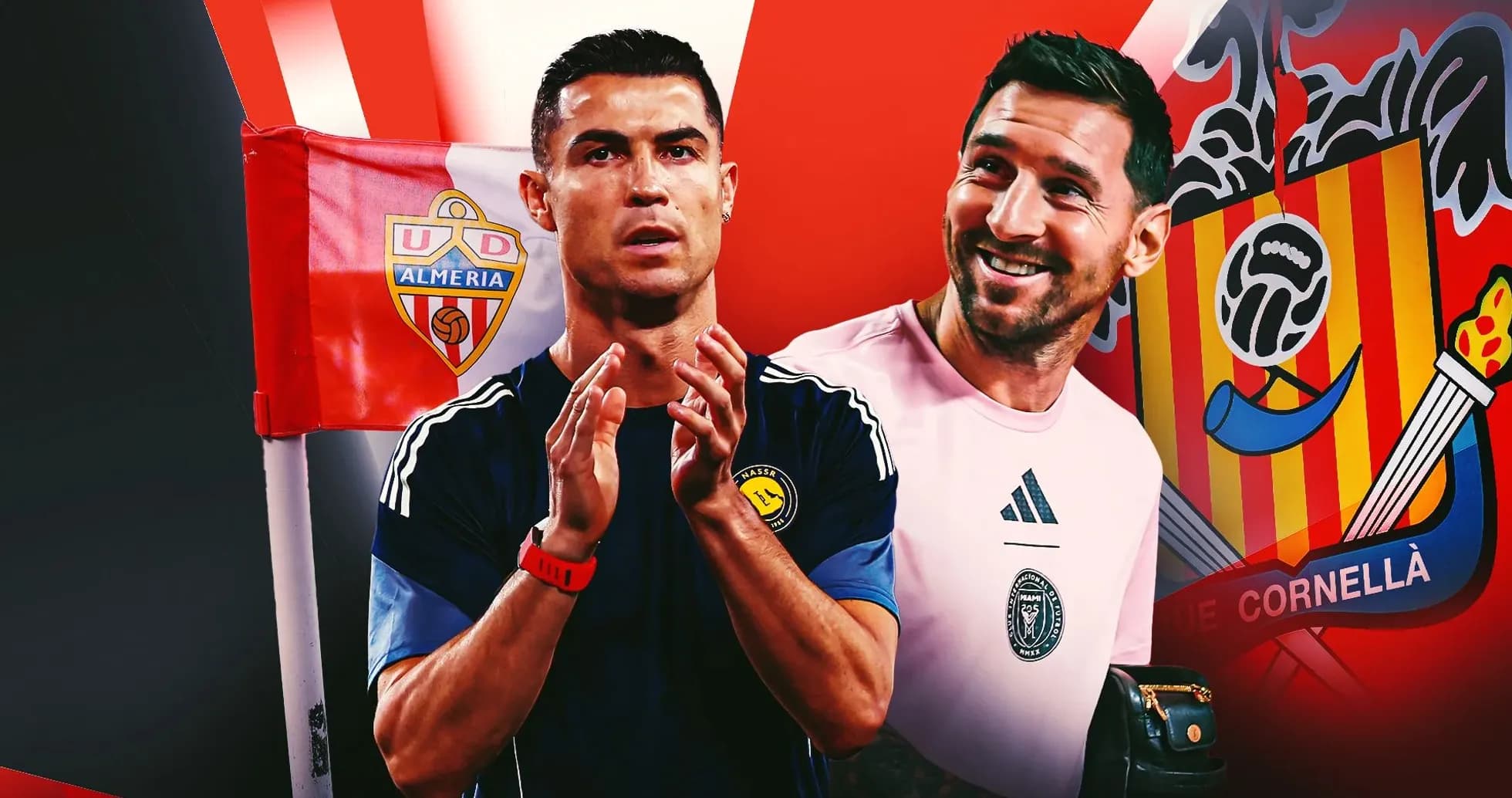
Lionel Messi, Cristiano Ronaldo, Kylian Mbappé, Luka Modrić, Vinícius Júnior, Thibaut Courtois. For two decades they’ve shaped football from the pitch. Now they’re quietly redrawing it from the boardroom.
This isn’t the old image of retired greats drifting into punditry or a token ambassador role. This is ownership. Control. Equity. And it’s stretching from Catalonia’s fifth tier to the sharp end of Ligue 1 and La Liga.
Messi goes home – via the fifth tier
In April, UE Cornellà, a modest club in Spain’s fifth division, dropped a bombshell: Lionel Messi had completed a 100 percent takeover.
Cornellà sit in the south-west of Barcelona, a short drive from the city where Messi ruled for 17 years in Barça colours. The club framed the deal as a natural extension of that bond, saying it “reinforces Messi’s close ties to Barcelona and his commitment to the development of sport and local talent in Catalonia”.
Messi didn’t just sign papers. He appeared in a video to players and staff, formally introducing himself and backing their promotion push. They fell short in the play-offs, but the impact was immediate in other ways.
Cornellà’s Instagram exploded into the hundreds of thousands. A local fifth-tier side suddenly had a global audience. Behind the noise, there is already a respected academy structure, one Messi intends to fuel with investment in Catalan talent.
The pathway is proven. Jordi Alba came through Cornellà. So did current Barça player Gerard Martin and Arsenal goalkeeper David Raya. This is a club that has punched above its weight before, famously dumping Atlético Madrid out of the Copa del Rey in 2021.
For Messi, Cornellà is only one piece. He is also an active owner in Uruguay, where, alongside Inter Miami strike partner Luis Suárez, he created Deportivo LSM, a new professional club in the country’s fourth tier. The playing days may be winding down. The projects are only just starting.
Ronaldo trades the touchline for the boardroom
Cristiano Ronaldo has never hidden his ambition. Not on the pitch. Not off it.
“If I can be a club owner, why would I be a manager, sporting director or CEO?” he said after turning 40, outlining a future where he wants to own “several” clubs. The first step came in February, when his CR7 Sports Investments company acquired a 25 percent stake in Spanish Segunda side Almería.
“It has been a long-held ambition of mine to contribute to football, beyond the pitch,” Ronaldo said in a statement. “UD Almeria is a Spanish club with strong foundations and clear potential for growth.”
Almería’s majority ownership remains in the hands of a Saudi-led consortium fronted by Mohammed Al-Khereiji, who hailed Ronaldo as “the greatest to ever play the game” and a man who “knows the Spanish leagues very well”. He should. Nine years at Real Madrid, two La Liga titles, four Champions Leagues and a club-record goal tally give him a deep understanding of the terrain.
Almería’s potential is not theoretical. They were in La Liga as recently as 2024 and only just missed an instant return, losing 2-1 on aggregate to Málaga in the play-off final. The response was aggressive: García Pimienta, a highly regarded coach forged over two decades in Barcelona’s La Masia, arrived, along with seven new signings, to target automatic promotion in 2026-27.
Ronaldo’s dual life produced a surreal scene in August. In Lisbon, Almería faced Al-Nassr in a pre-season friendly. From the stands, Ronaldo watched the club he plays for lose 2-0 to the club he co-owns. Few players have ever straddled the sport quite like this.
Vinícius Júnior and the rebirth of Alverca
In Portugal, another Real Madrid star has gone a different route.
In February 2025, Vinícius Júnior joined a group of investors to buy between 70 and 80 percent of Alverca for a reported €10 million. The timing could hardly have been better. Three months later, Alverca secured a second straight promotion and returned to the top flight for the first time since 1998.
This is a club that had already lived a lifetime. Relegated from the top division, Alverca folded in 2005, only to be reformed a year later and dragged slowly back up through the regional leagues. When the Vincintin family, who also own Santa Clara, were forced to sell because league rules forbid ownership of two clubs, Vinícius and his partners moved.
He has chosen distance over day-to-day meddling. His agent, Thassilo Soares, now holds the majority share. “Our relationship with Vinícius is remote,” sporting director Fernando Malta told Get French Football News, in quotes published by The Guardian. “We say he is the club’s most famous fan.”
Yet the effect is tangible. Alverca’s Complexo Desportivo welcomed Vinícius for the first time early last season for a match against Benfica. The club then finished 10th in their first campaign back in the elite, powered by a staggering 35 signings.
Malta is realistic. He doesn’t see Alverca challenging Porto, Sporting CP and Benfica for titles. The priorities are clear: stay in the division, sell well, and be clever. “We are not a big club in terms of size, so we need to be creative in our scouting and use of data,” he said. “The club’s main objective is staying in the top division but the second is selling players.”
Star power still matters. Vinícius’ presence helps attract talent, while Eduardo Camavinga and American rapper Travis Scott are on board to support communication and marketing. For a once-defunct club, it’s a remarkable new chapter.
Mbappé’s tough lesson at Caen
Not every superstar-ownership story glows.
In June 2024, Kylian Mbappé completed a takeover of SM Caen through Interconnected Ventures, the company he founded, using its investment arm Coalition Capital. The Real Madrid and France forward, who nearly joined Caen’s academy in 2012 before choosing Monaco, reportedly invested €15 million of his own money.
Caen framed the deal as a turning point, saying it “marks a significant step in the club’s strategic development and reinforces its natural ambition to remain among the historic places in French football”. At that moment, they were in Ligue 2 and eyeing promotion.
The slide was brutal. Caen finished the 2024-25 season in 18th and were relegated to the Championnat National, France’s third tier, for the first time in 41 years. Results nosedived, popular coach Nicolas Seube was sacked, and protests erupted. One banner after a damaging defeat to Clermont Foot cut to the bone: “SMC is not your toy”.
Mbappé has struggled to juggle Real Madrid obligations with the demands of running a professional club. Still, he made a bold call late last year, appointing former Arsenal and France defender Gaël Clichy as head coach. Clichy steadied the ship, though Caen still missed the play-offs in May.
Optimism has crept back in. This summer, Mbappé approved the arrival of former Caen and Paris Saint-Germain midfielder Mathieu Bodmer as director of football. L’Équipe reported that the pair did not speak before the appointment, a detail that underlines the distance between star owner and day-to-day operations.
Caen now chase an immediate return to Ligue 2. For Mbappé, the project has become a live test of whether his influence can extend beyond the pitch into something more durable.
Modrić and the Swansea experiment
In Wales, a different kind of fairytale unfolded.
Shortly before ending a glittering 13-year spell at Real Madrid last summer, Luka Modrić became a minority investor and co-owner at Swansea City. His message to supporters in the club’s press release felt almost surreal: “Hi Swansea fans, I’m Luka Modric and I’m excited to be part of the journey. My goal is to support the club’s growth in a positive way and to help to build an exciting future.”
For Swansea’s American ownership group – Andy Coleman, Brett Cravatt and Jason Cohen – Modrić was the marquee name they had been chasing, inspired by the transformative impact of Ryan Reynolds and Rob McElhenney at Wrexham. Modrić already knew Swansea from his Tottenham days, having faced them home and away in 2010-11, and The Guardian has reported that his decision was driven by a desire to learn the business side of the game.
He has thrown himself into understanding Swansea’s growth strategy and even volunteered to speak directly with transfer targets. For now, he remains a background presence at the Swansea.com Stadium. That is expected to change when the 40-year-old finally retires from playing, currently starring in Serie A for AC Milan.
Even in the shadows, his name has shifted Swansea’s profile. Snoop Dogg joined as an investor a couple of months after Modrić, with Martha Stewart following in December. “It puts us in a different league in terms of some of the things that we are able to do,” chief executive Tom Gorringe said.
The club’s ambition is blunt: get back into the Premier League after a nine-year absence. Swansea missed the Championship play-offs in 2025-26 by nine points. As the new campaign begins, having one of the game’s sharpest midfield minds on call for advice is a powerful asset.
Courtois builds a network
Thibaut Courtois might be the most strategic of them all.
At 34, still one of the world’s elite goalkeepers, the Real Madrid and Belgium star has already spread his influence across three clubs in less than a year.
In February, he joined an all-star ownership group at Le Mans, which already included Novak Djokovic and Felipe Massa. Courtois invested through NxtPlay Capital, the company he co-founded with Gonzalo Vilar. The timing was sweet: Le Mans have since celebrated a return to Ligue 1 for the first time since 2010.
Three months later, Courtois and NxtPlay became co-owners of CD Extremadura. The Spanish club have rocketed through four straight promotions since 2022, climbing into the Primera Federación, Spain’s third tier. It’s a classic investor’s dream: momentum, growth, and a fanbase rediscovering hope.
Then came the move that hit closest to home. On June 1, Genk announced Courtois’ return as a minority investor. This is where he began his professional career, and he seized the chance to become the club’s first external corporate shareholder after their shift to a limited liability structure.
“I have pursued excellence all my life. At KRC Genk, I feel that same fire and ambition,” Courtois told the club website. “This investment truly feels like coming home. Through this commitment, I want to help the club continue to grow and strengthen its sporting ambitions. From Limburg to the top of Europe.”
NxtPlay now has a seat on Genk’s board, with Vilar handling the role while Courtois continues in Madrid. Even so, the goalkeeper is actively shaping Genk’s commercial strategy, choosing projects with headroom for growth and a clear identity.
The long-term vision is unmistakable: a multi-club model, built player by player and market by market, echoing the structures of City Football Group, Red Bull and BlueCo.
From Cornellà to Caen, from Alverca to Swansea and Genk, football’s biggest names are no longer just lifting trophies. They are buying into risk, reputation and long-term responsibility. The only real question now is simple: which of these star-powered projects will still be standing, and winning, when the boots are finally hung up for good?