.svg&w=384&q=75 "GoalGist logo")
FK Crvena Zvezda Dominates Plzen 3-0 in Tactical Showcase
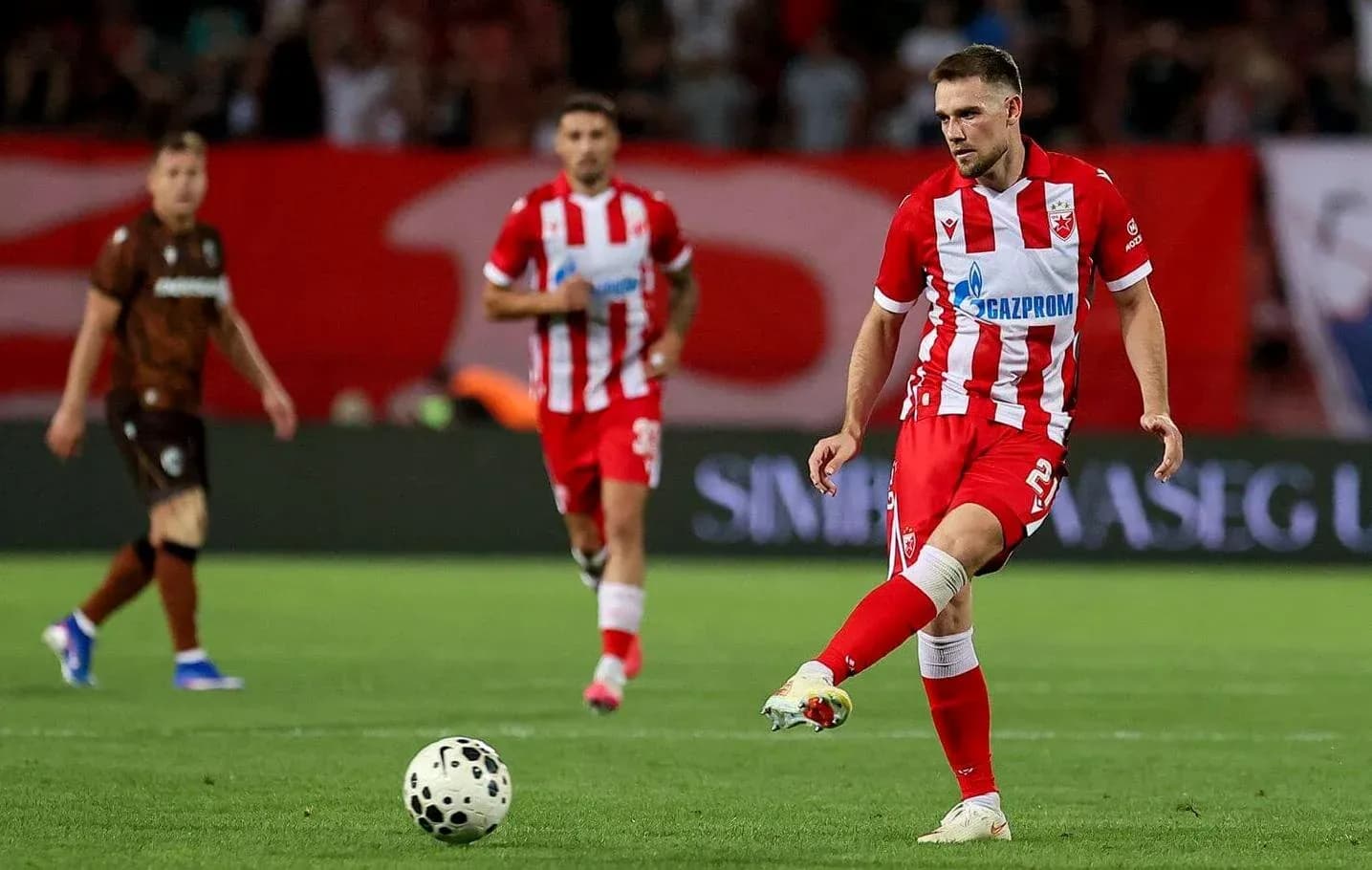
FK Crvena Zvezda’s 3-0 win over Plzen at Stadium Rajko Mitić was a controlled, structurally coherent European home performance built from a clear 4-3-3 framework against a 4-4-1-1 that never fully solved the central overloads. Despite a perfectly even 50%-50% share of possession, the hosts dictated where the game was played and how transitions unfolded, turning parity on the ball into superiority in territory, pressure and chance quality.
Albert Riera’s 4-3-3 was defined by its interior triangle and wide-midfield hybrid roles. The back four of Seol Young-Woo, D. Luckassen, M. Veljkovic and T. Elsnik sat behind a midfield of M. Ivanic, R. Krunic and V. Kostov, with O. Bukari and M. Cham flanking centre-forward M. Arnautovic. Functionally, Elsnik operated as a left-sided defender stepping into midfield in possession, allowing Kostov and Ivanic to occupy advanced half-spaces, while Krunic anchored circulation.
Against that, Martin Hysky’s Plzen lined up in a 4-4-1-1: F. Wiegele in goal, a back four of A. Memic, S. Dweh, D. Krcik and M. Doski, a flat-ish midfield line of T. Ladra, L. Cerv, F. Prebsl and C. Souare, with P. Hrosovsky supporting lone striker P. Adu. The idea was to block central progression with a compact box around Krunic and Ivanic, then break through the wide channels via Ladra and Souare.
Crvena Zvezda’s key tactical edge came from how they manipulated that Plzen box. Ivanic repeatedly found pockets between Cerv and Prebsl, receiving on the half-turn and linking with Elsnik on underlaps. The first goal at 36' was emblematic: M. Ivanic (FK Crvena Zvezda), assisted by T. Elsnik, capitalised on that left half-space connection to make it 1-0, a pattern Plzen struggled to adjust to even after the interval.
Out of possession, Zvezda’s front three pressed in a curved line, steering Plzen’s build-up away from the centre-backs and onto full-backs Memic and Doski. With only 2 corner kicks and 6 fouls drawn, Plzen’s territorial presence in the final third was limited; they did register 5 shots on goal and 1 shot off goal, but those efforts largely came from isolated breaks rather than sustained pressure. The 4-4-1-1 struggled to provide Adu with consistent support once Hrosovsky was forced deeper to help Cerv in build-up.
Riera’s side, by contrast, converted their structural superiority into volume and variety of attempts: 7 shots on goal, 5 off goal and 1 blocked shot. The distribution of these attempts, rather than the raw totals alone, showed a team comfortable alternating between patient combinations and more direct deliveries into Arnautovic. Cham and Bukari’s positioning as high, narrow wide-midfielders meant Zvezda could quickly flood the central lane with three or four options, forcing Plzen’s back line to collapse and opening the edges for overlaps.
The second Ivanic goal at 53' again came via T. Elsnik’s supply, underlining how Zvezda’s left side functioned as the primary creative corridor. At 2-0, Riera immediately began to manage energy and control. The 72' double change — J. Enem (IN) came on for M. Arnautovic (OUT), and A. Katai (IN) came on for M. Ivanic (OUT) — subtly reoriented the attack. Enem offered more vertical running to stretch a tiring Plzen back line, while Katai became the new reference between the lines, protecting possession and drawing fouls and pressure.
Plzen’s response through substitutions was largely reactive. At 46', C. Kabongo (IN) came on for C. Souare (OUT) to inject fresh legs on the flank, but the overall 4-4-1-1 structure remained unchanged. Later, S. Pirgic (IN) for T. Ladra (OUT) at 61', D. Visinsky (IN) for F. Prebsl (OUT) at 73', M. Vydra (IN) for P. Adu (OUT) also at 73', and finally K. Spacil (IN) for D. Krcik (OUT) at 86' all pointed to a search for individual impact rather than a systemic shift. The basic problem — numerical and positional inferiority in central zones — persisted.
Zvezda’s late-game substitutions further underlined their game management. At 84', M. Bajo (IN) came on for V. Kostov (OUT), adding fresh legs in midfield to preserve compactness. At 85', F. Tebo Uchenna (IN) came on for D. Luckassen (OUT), and at 90', L. Loizou (IN) came on for O. Bukari (OUT), ensuring defensive stability and ball retention in the final minutes. These moves protected the clean sheet while maintaining enough offensive threat to keep Plzen pinned back.
Discipline played a subtle tactical role. FK Crvena Zvezda collected 2 yellow cards (Young-woo Seol and Vasilije Kostov), while Plzen accrued 4 (Cheick Souaré, Patrik Hrošovský, Sampson Dweh, Karel Spáčil). The higher card count for Plzen reflected the strain on their midfield and back line as they were repeatedly forced into late challenges to halt Zvezda’s combinations, especially once Katai entered and began receiving in tight pockets.
The third goal at 89' — A. Katai from the penalty spot — was the logical conclusion of Zvezda’s territorial dominance and control of transitions. The penalty was subsequently confirmed by VAR at 90', underlining both the composure of Katai in a high-pressure moment and the degree to which Plzen were being pulled into desperate, last-line interventions.
Statistically, the 3-0 scoreline sits comfortably within the pattern of play. Equal possession but a 7-to-5 edge in shots on goal, more shots off goal (5 to 1), and a lower foul count (5 to 6) for Zvezda point to a team that used the ball more efficiently, defended with structure rather than last-ditch challenges, and repeatedly created higher-quality situations. Even without explicit xG or passing figures, the shot profile and disciplinary balance corroborate the tactical impression: Zvezda’s 4-3-3, with its intelligent half-space occupation and well-timed substitutions, systematically dismantled Plzen’s 4-4-1-1 and turned a level share of the ball into a decisive advantage on the scoreboard.