.svg&w=384&q=75 "GoalGist logo")
Ferencvarosi TC vs Twente: Tactical Analysis of a 2-2 Draw
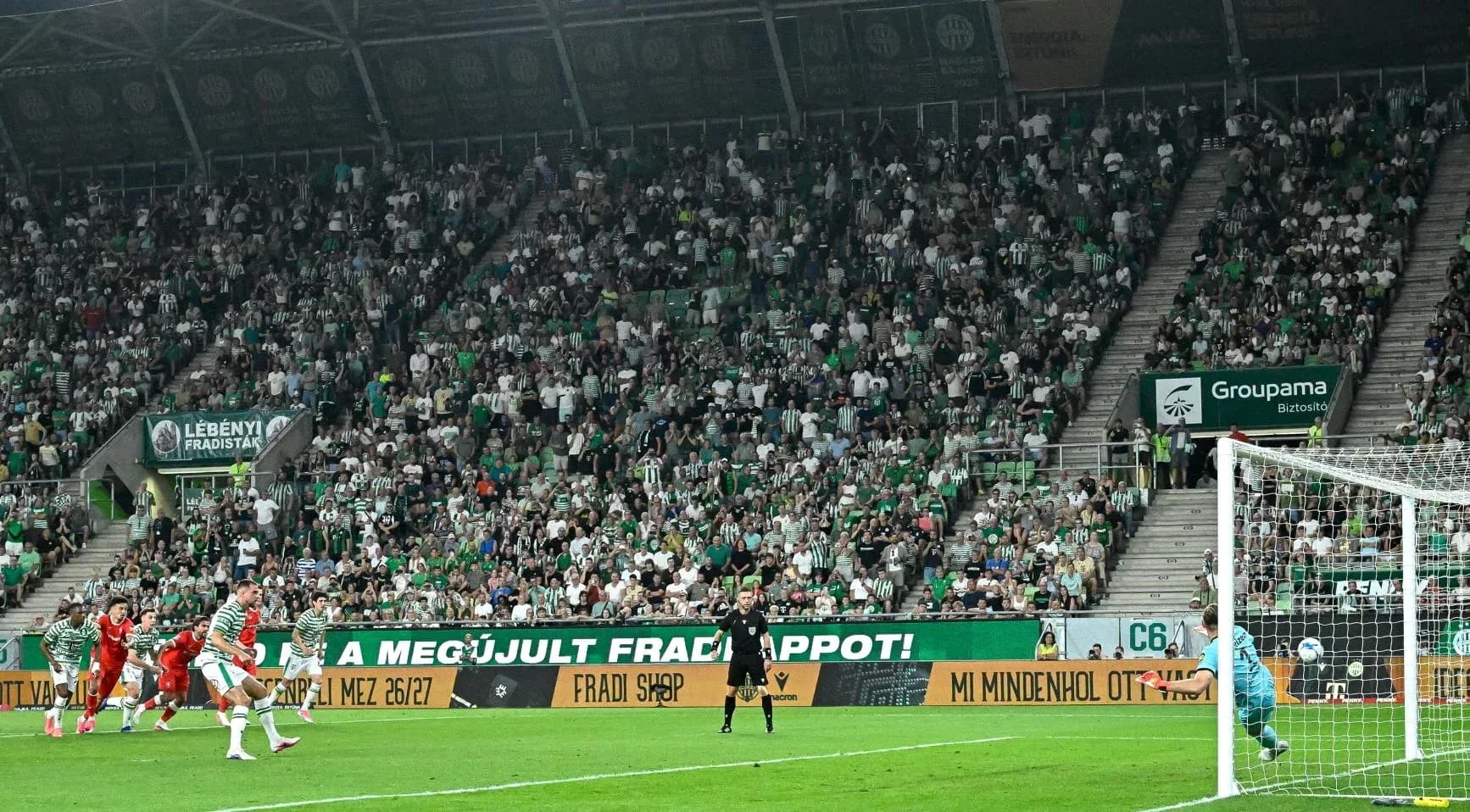
Ferencvarosi TC and Twente produced a tactically complex 2-2 draw at Groupama Aréna in the UEFA Europa League 2nd Qualifying Round, a match that pivoted dramatically on a first-half red card and contrasting interpretations of the 4-3-3. Ferencvaros led 1-0 at half-time and extended to 2-0 early in the second half despite playing with ten men from the 36th minute, but Twente’s structural and personnel adjustments eventually converted territorial control into two late goals, leaving the tie finely balanced.
Executive Summary
Balazs Borbely kept Ferencvarosi TC in a 4-3-3 with a midfield-heavy front line, while John van den Brom mirrored the shape for Twente. The hosts’ early penalty, converted by centre-back T. Raemaekers, and a transition goal from L. Joseph built what looked like a decisive 2-0 platform. However, the dismissal of P. Rommens forced Ferencvaros into a low defensive block for nearly an hour, inviting Twente pressure. Van den Brom’s bench—particularly the introduction of extra forwards and attacking midfielders—tilted the game, with W. Weghorst and L. Vennegoor of Hesselink striking on 82 and 86 minutes to salvage a draw that reflected Twente’s numerical and territorial superiority after the sending-off.
Scoring Sequence & Disciplinary Log
The scoring opened on 22': 22' T. Raemaekers (Ferencvarosi TC) — Penalty, no assist → Ferencvarosi TC 1-0 Twente. The centre-back’s conversion immediately altered Ferencvaros’ risk profile, allowing them to drop five to ten metres and protect central spaces.
Discipline became decisive on 36': 36' P. Rommens (Ferencvarosi TC) — Serious foul. The straight red card forced Borbely to sacrifice possession and pressing height, reorganising into a compact 4-4-1 with one midfielder less, fundamentally changing the match’s tactical landscape.
Early in the second half, the hosts struck again: 50' L. Joseph (Ferencvarosi TC) — Normal Goal, no assist → Ferencvarosi TC 2-0 Twente. This came against the run of the evolving numerical context, rewarding Ferencvaros’ direct transitions and the forward’s ability to exploit stretched central channels as Twente pushed higher.
The card sequence around the hour underlined rising tension:
- 56' Cadu (Ferencvarosi TC) — Unsportsmanlike conduct
- 56' T. van den Belt (Twente) — Unsportsmanlike conduct
- 61' S. Lemkin (Twente) — Unsportsmanlike conduct
Twente finally converted pressure into goals late on:
- 82' W. Weghorst (Twente) — Normal Goal, no assist → Ferencvarosi TC 2-1 Twente
- 86' L. Vennegoor of Hesselink (Twente) — Normal Goal, no assist → Ferencvarosi TC 2-2 Twente
The final card came as Twente continued to press in the closing minutes:
88' Y. Taha (Twente) — Foul
Card totals were clear: Ferencvarosi TC: 1 yellow, 1 red; Twente: 3 yellows; Total: 5 cards.
Tactical Breakdown & Personnel
Ferencvarosi TC’s starting 4-3-3 was built on a technically oriented midfield triangle of P. Rommens, G. Kanichowsky and M. Corbu ahead of a back four where Cadu and A. Osvath were nominally listed as midfielders but effectively operated as full-backs in the grid. With K. Zachariassen and C. O’Dowda flanking L. Joseph, Borbely’s side sought to overload the half-spaces, using Joseph’s central presence to pin Twente’s centre-backs and open inside lanes for third-man runs.
The early penalty to Raemaekers at 22' was emblematic of Ferencvaros’ set-piece organisation: centre-backs stepping into responsibility in high-leverage moments, while the midfielders focused on second balls and rest defence. At 11 v 11, Ferencvaros were able to press selectively, with Zachariassen and O’Dowda jumping onto Twente’s full-backs and Joseph screening passes into R. Zerrouki.
The 36' dismissal of Rommens forced an immediate reconfiguration. With one central midfielder gone, Ferencvaros effectively collapsed into a 4-4-1 out of possession, with one of the wide players dropping alongside Kanichowsky and Corbu to form a narrow second line. The priority became protecting the central corridor and limiting Twente’s ability to find Weghorst between the lines. The second Ferencvaros goal on 50', finished by Joseph, was a pure transitional strike: a quick vertical release exploiting Twente’s higher defensive line and the space behind their advanced full-backs.
Substitutions reflected the evolving game state. For Twente, the 46' double change—S. Lammers (IN) came on for K. Hlynsson (OUT) and D. Weidmann (IN) came on for A. Adelgaard (OUT)—signalled a shift towards greater attacking presence and more progressive passing from deep. Later, 63' Y. Taha (IN) came on for T. van den Belt (OUT), 72' M. Pjaca (IN) came on for D. Rots (OUT), and 72' L. Vennegoor of Hesselink (IN) came on for S. Orjasaeter (OUT) progressively loaded the front line with additional forwards and creative profiles. The late goals from Weghorst and Vennegoor of Hesselink validated that aggressive rotation: more penalty-box occupation, more second-phase presence, and more direct service into the area.
Ferencvaros’ substitutions were reactive and protective. At 73', Dele (IN) came on for C. O’Dowda (OUT), adding fresh legs in wide areas to support defensive transitions. On 78', N. Zohore (IN) came on for L. Joseph (OUT), sacrificing the main outlet in exchange for renewed defensive work and aerial presence deeper. At 88', J. Levi (IN) came on for Cadu (OUT), a late attempt to inject energy into a tiring, numerically disadvantaged side.
Both goalkeepers—D. Dibusz (Ferencvarosi TC) and L. Unnerstall (Twente)—played within the structural demands of their teams, but specific save counts and goals prevented cannot be assessed from the available data. What is clear is that, once reduced to ten men, Ferencvaros relied heavily on Dibusz’s positioning and the compactness of the back four to absorb crosses and direct play aimed at Weghorst.
The Statistical Verdict
Key attacking and possession metrics are not available, but the event pattern itself outlines the game’s statistical narrative. Ferencvaros scored twice from open play and a penalty while playing over 50 minutes a man down, indicating high efficiency relative to their likely share of possession and chance volume. Twente, by contrast, required sustained pressure and a series of attacking substitutions to finally convert their territorial dominance into two late goals.
Discipline clearly tilted against Ferencvaros in impact if not in raw count: their 1 yellow and 1 red had far greater structural consequences than Twente’s 3 yellows, especially with the red arriving before half-time. The late clustering of Twente’s goals (82' and 86') suggests that fatigue and numerical inferiority eventually eroded Ferencvaros’ defensive organisation.
In the context of a two-legged qualifier, a 2-2 home draw from a 2-0 lead will feel like a missed opportunity for Ferencvaros, but the underlying tactical story—playing an hour with ten men and still carrying a lead into the final ten minutes—also hints at resilience and a clear defensive identity. For Twente, the data and flow point to superior depth and the ability to reshape matches from the bench, a factor that could be decisive in the return leg.