.svg&w=384&q=75 "GoalGist logo")
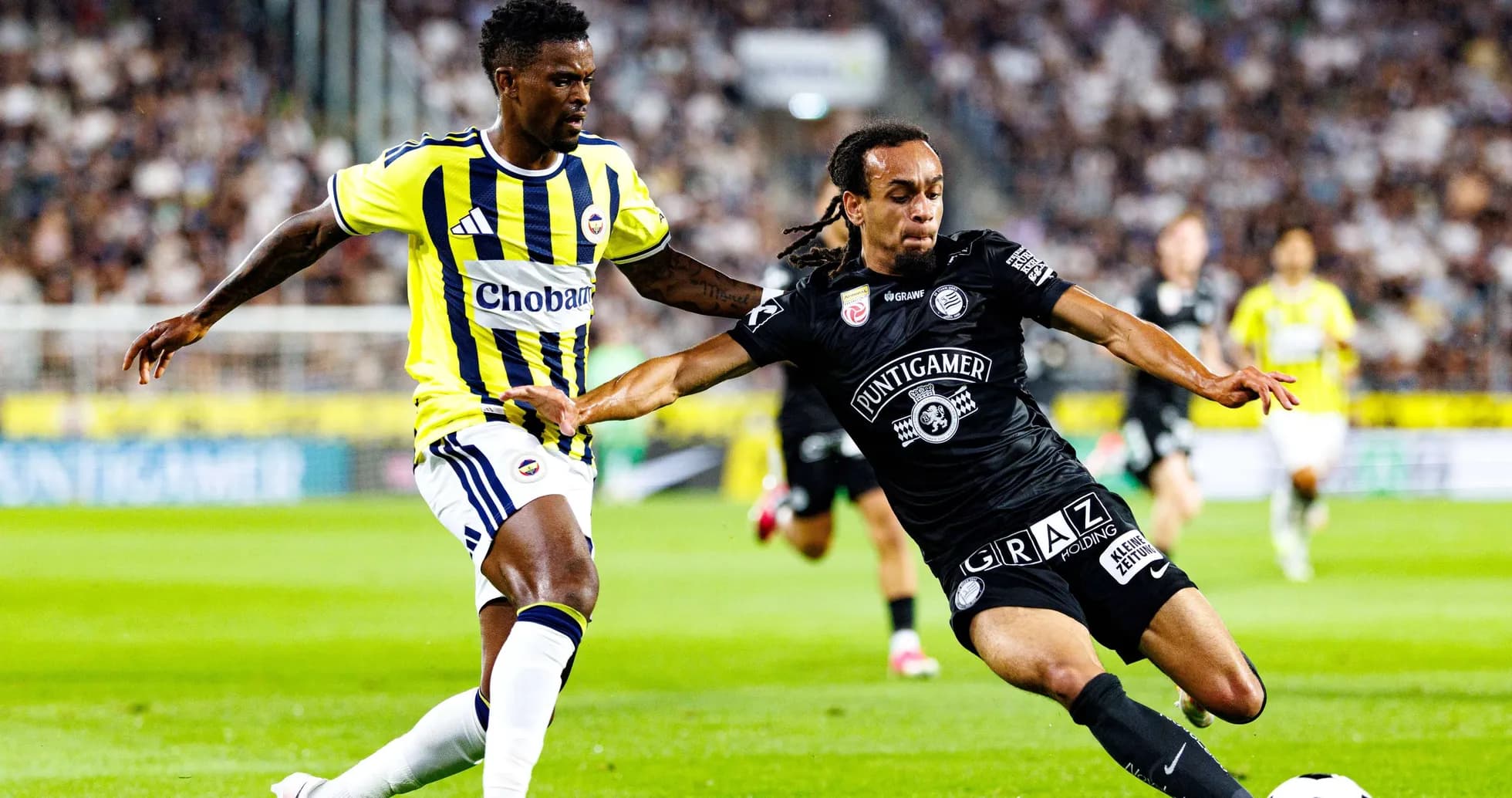
Fenerbahçe's Tactical Superiority Over Sturm Graz in UEFA Champions League
Sturm Graz’s 4-4-2 at Merkur Arena was built on volume and verticality, but across 90 minutes Fenerbahçe’s 4-2-3-1 showed greater control of key zones and efficiency in both boxes, which ultimately underpinned the 0-1 away win in this UEFA Champions League 3rd Qualifying Round tie.
Fabio Ingolitsch set Sturm Graz up in a classic 4-4-2 with D. Khudyakov in goal, a back four of E. Soglo, P. Petrovic, J. Mitchell and A. Malic, a flat midfield line of J. Hödl, L. Weinhandl, J. Gorenc Stankovic and S. Seidl, and a front pair of A. Kayombo and S. Jatta. The structure aimed to press high in straight lines and attack early through the channels, reflected in their 19 total shots and 7 corners. However, only 6 of those efforts came from inside the box and just 2 hit the target, illustrating how often their attacks were forced into low-quality, long-range attempts by Fenerbahçe’s compact block.
Ismail Kartal’s Fenerbahçe, by contrast, used a 4-2-3-1 that was extremely clear in its roles. With M. Günok in goal, a back four of Archie Brown, Nélson Semedo, M. Škriniar and N. Aké sat behind the double pivot of N. Kanté and M. Guendouzi. Ahead of them, M. Greenwood, M. Asensio and Kerem Aktürkoğlu supported Talisca as the lone striker. The double pivot was decisive: Kanté and Guendouzi screened the half-spaces, stepped out to meet Sturm’s wide midfielders, and repeatedly forced Sturm’s possession into wide and backward passes. Despite the hosts matching Fenerbahçe with 50% of the ball, the Turkish side dictated where that possession occurred.
Defensive Structures
The defensive structures tell the story of the shot profile. Sturm Graz blocked 9 shots, indicating an aggressive, last-ditch defending approach around their own box. Fenerbahçe, by comparison, needed only 2 blocks, because their line of engagement and midfield screen reduced Sturm’s ability to work the ball into central danger zones. Fenerbahçe produced 11 total shots, 8 from inside the box and 6 on goal, showing a much more selective, penalty-area-focused attack that ultimately yielded the decisive penalty converted by Talisca.
In goal, D. Khudyakov (Sturm Graz) made 5 saves, which, combined with the 6 Fenerbahçe shots on target, indicates he was consistently exposed to high-quality chances despite Sturm’s territorial spells. His interventions kept the scoreline narrow and gave the home side a platform to stay in the tie. At the other end, M. Günok (Fenerbahçe) needed to make only 2 saves from Sturm’s 2 shots on target, a testament to how well the visitors protected their box and limited clear looks at goal despite allowing 19 attempts overall.
Passing Data
Passing data underlines the tactical balance. Sturm Graz completed 383 total passes, with 311 accurate at 81%. Fenerbahçe completed slightly more at 397 total passes, 318 accurate at 80%. The near-identical possession (50%-50%) and similar pass volumes suggest neither side dominated the ball; instead, the difference lay in how each team used it. Sturm’s 4-4-2 often progressed via quicker, more direct patterns into the channels for Kayombo and Jatta, but the final ball lacked precision and composure, leading to a high count of shots outside the box (13). Fenerbahçe’s 4-2-3-1, however, used the double pivot to circulate and then punch vertical passes into the feet of Talisca and the three attacking midfielders, creating more controlled entries into the penalty area.
Set Pieces and Wide Play
Set pieces and wide play were another key battleground. Sturm’s 7 corner kicks reflect their ability to reach the final third and force defensive actions from Fenerbahçe, but the visitors’ aerial and positional discipline in the box, anchored by Škriniar and Aké, prevented those dead-ball situations from turning into clear chances. Fenerbahçe’s 6 corners at the other end mirrored their own attacking threat, but with 8 shots inside the box, much of their danger came from open-play combinations rather than simply loading the area from restarts.
Substitution Pattern
The substitution pattern reveals how both coaches tried to tilt the tactical balance in the second half. At 61', Ingolitsch reshaped his attack: B. Beganovic (IN) came on for S. Jatta (OUT), J. Heil (IN) came on for A. Malic (OUT), and N. Weiper (IN) came on for A. Kayombo (OUT). This triple change aimed to refresh the front line and right flank, inject more energy between the lines, and push full-backs higher. Later, R. Fosso (IN) for J. Gorenc Stankovic (OUT) at 70' added a more progressive midfield profile, and P. Koller (IN) for P. Petrovic (OUT) at 79' further altered the back line to support late pressure.
Kartal’s response was equally structured. Once Nélson Semedo had been booked and the game state shifted after the penalty, he introduced M. Muldur (IN) for N. Semedo (OUT) at 62' to stabilise the right flank. Fred (IN) replaced M. Asensio (OUT) at 63', and O. Aydin (IN) came on for M. Greenwood (OUT) in the same minute, giving fresh legs and slightly more conservative profiles in the attacking midfield band to protect the lead while retaining counter-attacking threat. I. Yuksek (IN) for N. Kanté (OUT) at 73' and V. Muriqi (IN) for Talisca (OUT) at 77' shifted the side toward a more physically robust, hold-up oriented shape for the closing stages, with Muriqi providing an outlet to relieve pressure and Yuksek adding defensive industry in midfield.
Discipline and Tactical Tone
Discipline also influenced the tactical tone. Fenerbahçe committed 13 fouls to Sturm’s 12 and collected 3 yellow cards (Nélson Semedo, Archie Brown, Kerem Aktürkoğlu all for “Foul”), while Sturm had 1 yellow card (Jeyland Mitchell, also for “Foul”). The visitors’ higher card count reflects a willingness to break Sturm’s transitions with tactical fouls, particularly as the hosts pushed more bodies forward after falling behind.
In sum, this was a match where surface metrics—possession and pass counts—suggest parity, but tactical detail shows Fenerbahçe’s structure in the 4-2-3-1 produced clearer chances, better box protection, and more efficient use of territory. Sturm Graz’s 4-4-2 generated volume and pressure but lacked the central penetration and shot quality to convert that into goals, leaving them with a narrow 0-1 deficit despite significant effort and late structural gambles.