.svg&w=384&q=75 "GoalGist logo")
Enzo Maresca Takes Over Manchester City: A Privilege and a Challenge
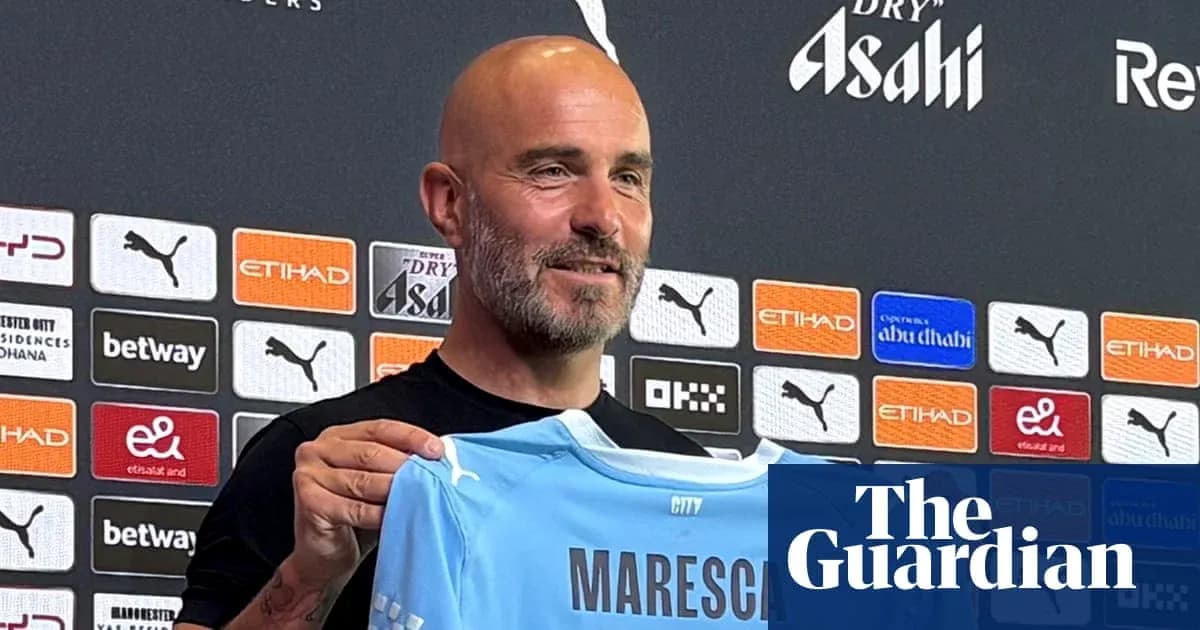
Enzo Maresca walked into Manchester City with his eyes wide open. How could they not be? He is the man asked to step into Pep Guardiola’s office, sit in his chair and keep the most relentless winning machine in English football history humming.
He calls it a privilege. It is also a test that has broken great clubs before.
Living in Pep’s Shadow
At his first press conference as City manager, Maresca did not try to shrink the scale of what he has taken on. Guardiola leaves behind 17 major trophies in 10 years and a body of work that has redefined the club and, in many ways, the league.
“First of all, I have to say that it’s a privilege because the club decided to go for me,” the Italian said, making clear he understands exactly whose footsteps he is following. He has long rated Guardiola as “probably the best coach in the world in the last 20, 25 years” and now inherits the empire he built.
The warning signs from elsewhere are obvious. Maresca referenced them himself. Manchester United’s sharp decline after Sir Alex Ferguson handed over to David Moyes in 2013. Arsenal’s long, uneven search for stability after Arsène Wenger stepped down in 2018 and Unai Emery came in.
“It’s a challenge. It’s nice,” Maresca said. “Also, the history of the manager with many years in the same club always struggled a little bit. After Sir Alex, after Arsène.” He knows the pattern. He is determined not to repeat it.
The key, in his view, lies in the club’s foundations.
Betting on City’s Structure
Where United and Arsenal lurched through short-term fixes and identity crises, Maresca believes City’s structure gives him a platform to succeed.
“The organisation is the main thing,” he said. Then he pointed to a detail that underlines City’s stability: three managers in 17 years – Roberto Mancini, Manuel Pellegrini and Guardiola. “This is not normal. It doesn’t happen often.”
That continuity, he feels, is his ally. He is not arriving to rip anything up. He is stepping into a system that has been refined since Mancini’s title breakthrough, carried on under Pellegrini and then turbocharged by Guardiola.
“I’m confident that we can do a great job,” Maresca said. “We can continue to do the job that has been done since Roberto was here, then after Manuel and for 10 years Pep.”
The message is clear: evolution, not revolution. But the smooth transition he wants has already been complicated by a key absentee.
Rodri Blow and Real Madrid Noise
City’s new era will begin without its midfield metronome. Maresca confirmed that Rodri will undergo back surgery on Monday and is set to miss the start of the season.
For a side built on control, losing the player who provides most of it is a serious early problem. The situation is sharpened by the backdrop of Real Madrid’s interest in the 30-year-old, though Maresca cut through the noise when asked about the midfielder’s future.
“First of all, around big players there is always speculation,” he said. “I’m not worried about that.” Rodri’s stock has never been higher after Spain’s World Cup triumph, where he was named among the standout performers. “I think every manager wants to have Rodri because he’s a top player,” Maresca added.
For now, the priority is recovery. “He has surgery on, I think, Monday. He needs holiday, rest. Then he will be back here with us.”
City must navigate the opening weeks without the man who knits their game together. Maresca’s first tactical puzzle as manager is a demanding one.
Futures in the Balance: Grealish and Trafford
The new manager also faces decisions on the fringes of his squad, where careers can tilt one way or the other with a single window.
Jack Grealish is back at City after last season’s loan at Everton, but his long-term place is uncertain. Leeds are interested in James Trafford, now the second-choice goalkeeper, and Maresca knows the young keeper well from their time together with City’s Under-23s in 2020-21.
“Jack, at the moment, he’s a Man City player,” Maresca said, stressing that his first responsibility is to coach those currently on the books. “I like to know if there are players that belong to the club, it’s my duty to try to coach them. Then we see what happens.”
On Trafford, the line was similar, but with the realism of a man who understands how volatile a transfer window can be. “I know James because he was my keeper when I was with the City Under-23s. But again, when the transfer window is open now, January, anything can happen. So we see. But at the moment, he’s one of our keepers.”
Nothing dramatic, no grand declarations. Just a manager keeping his options open while the market does what it always does.
Maresca steps into a job that has devoured lesser projects at other giants. He has the weight of Guardiola’s legacy on his shoulders, a midfield linchpin heading for surgery, and key squad calls to make before a ball is kicked.
He calls it a privilege. Soon enough, the Premier League will show whether it becomes an opportunity seized or another cautionary tale in the brutal art of succession.

