.svg&w=384&q=75 "GoalGist logo")
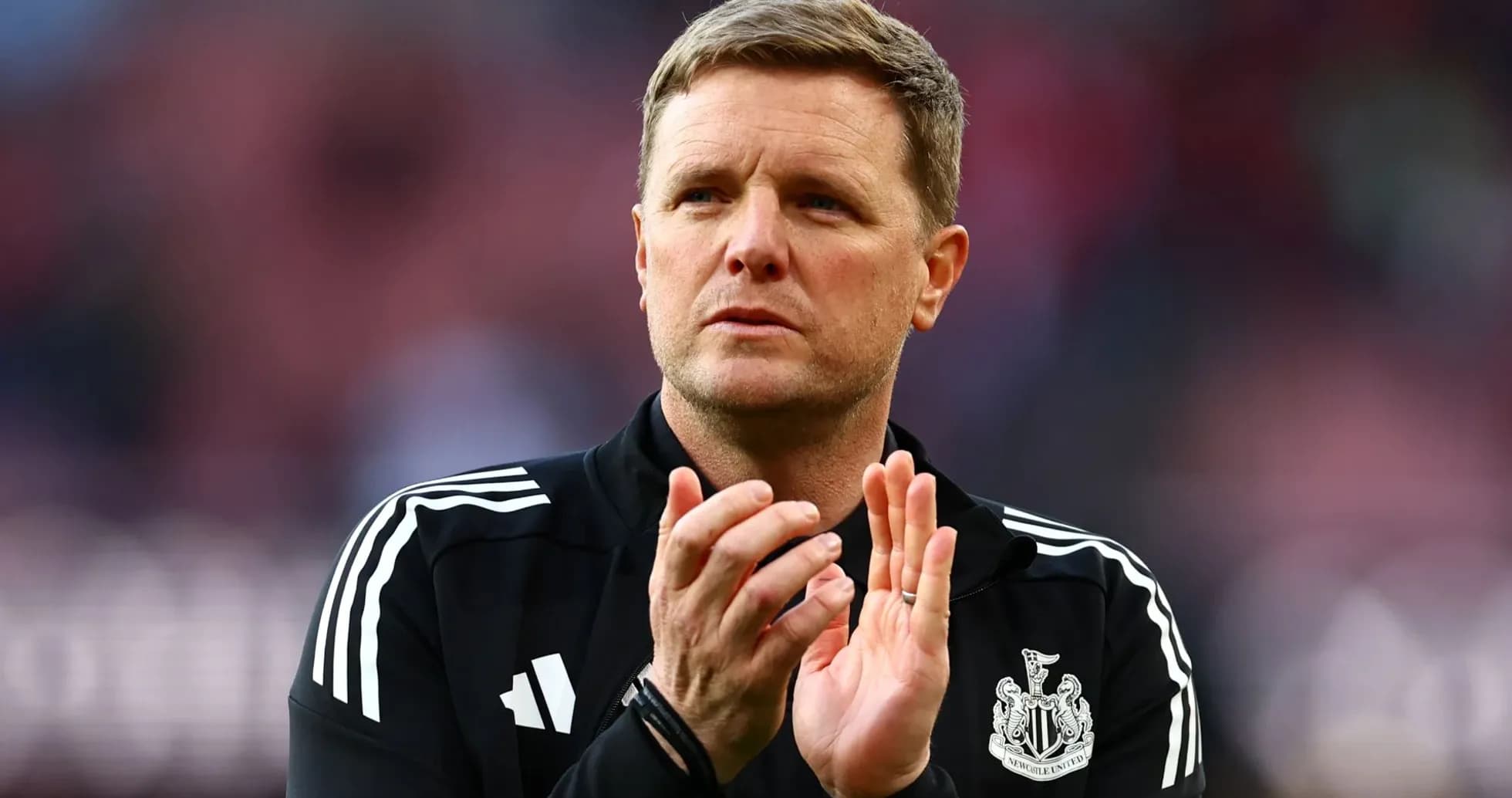
Eddie Howe's Departure: A Turning Point for Newcastle
Eddie Howe walked out of St James’ Park on July 30, 2026, leaving behind a Champions League club, a League Cup in the cabinet and a fanbase that had finally started to believe again. For the first time in 70 years, Newcastle had a domestic trophy to polish. For the first time in a generation, they had a manager who felt built to last.
Then he was gone.
Across 231 games, from November 2021 to that summer farewell, Howe had dragged Newcastle from relegation anxiety into Europe’s elite. He became one of the longest-serving managers in the Premier League almost by stealth, quietly rebuilding a club that had forgotten how to dream. But the winds that blew him into Tyneside eventually blew him back out again, and this time they carried more than one big name with them.
- Anthony Gordon to Barcelona.
- Sandro Tonali to Tottenham.
- Bruno Guimaraes edging towards a £75 million move to Arsenal.
The spine of Howe’s project, stripped in a single window. Newcastle are not just evolving; they are being dismantled in real time.
So when Chris Waddle looks at Howe’s decision and talks about a “sinking ship”, he is not exactly reaching for the hyperbole drawer. The former Magpies winger, speaking to GOAL in association with BetBrain, understands why the manager chose this moment to walk away.
“Eddie, he's built a good squad,” Waddle said. “Last year, the season, the signings he made didn't work. They struggled. The team struggled, let's be honest, week in, week out.”
That is the sting in Howe’s Tyneside tale. The first act was exhilarating: high pressing, front-foot football, a style that matched the city’s mood and the club’s new ambition. The League Cup win. The Champions League qualification. Then a second qualification. The noise around St James’ Park felt like the 1990s again, only this time with a trophy to show for it.
The second act was harder. Recruitment misfired. Injuries bit. Newcastle lost rhythm, lost fluency, and with it, some of their fear factor. Howe, still popular, still admired for his attacking principles, suddenly found himself looking at a squad that no longer resembled the one he thought he was building.
Waddle did not sugar-coat the dilemma.
“Losing Tonali, losing Gordon, bringing three unknown players in, let's be honest, young players and Guimaraes looks like he's going to go to Arsenal – he's probably thought, ‘I can't make this team a top four, top six team, which people want’. And he's probably thought, ‘I've done as much as I can here and it's time to move on’.”
That is the crux. Howe leaves not as a failure, not even as a nearly man, but as a coach who hit the ceiling of what he believed this version of Newcastle could be. The project that once looked like a launchpad now resembles a reset.
Inevitably, the conversation shifts to England. It always does when an English manager with a modern, progressive reputation becomes available. Howe has long been floated as a future national team boss, and England’s limp semi-final exit at the 2026 World Cup only sharpened that focus.
Thomas Tuchel, with his stellar club CV, could have felt the heat. According to Waddle, he should not.
“No, I think he’ll be given time,” Waddle insisted. “He's got a great record as a club manager. International football is different, we know that. You can't go and buy a centre-half, you can't buy players, you've got to work with what you've got.”
England, in his eyes, did about as much as they were ever likely to.
“They did okay. I didn't think they were ever going to win it, when the tournament started and watching it. I thought they'd get to the latter stages, as they did, but I didn't fancy them ever to win it.”
The problem, as Waddle sees it, is not the man in the dugout but the tools at his disposal. England’s squad remains deep, talented and competitive, but incomplete.
“It's just finding that right blend and what we are short of is a good number 10 and a really, really top, top winger. And if we could find them two players, it would help his cause a lot more. But at the minute, I think we've got a strong squad. It will give anybody a game, we know that. But we're just missing something.”
So if England is not Howe’s immediate destination, where does he go? This is where Waddle becomes more prescriptive.
He does not claim to know Howe personally. What he does know is the profile: obsessive, private, almost monastic in his devotion to the job.
“You don't really hear a lot about him. You don't see him around. He's football, home, football, home, by all accounts.”
For Waddle, that intensity needs a new landscape.
“If I was Eddie Howe, I would go abroad now for a year or two and learn my trade a bit more abroad and come back. And then I think he'd be ready for England in two years, after the next Euros.”
The Premier League, of course, will come calling. It always does. Chairs wobble after six games, projects implode after 10, and suddenly a manager with Howe’s track record becomes the obvious answer to someone else’s crisis.
“It's always the case with the Premier League that jobs come up – there will be a few come up after six, 10 games, we know that is always the case. Getting Eddie Howe in, we know he can manage in the Premier League. He's done it well.”
But Waddle wants more for him than a quick return to the same treadmill.
“To go and learn more, you need to go abroad and find out what life's about and what coaching’s about. Because when you go abroad, you're a coach. You're not a manager, you're a coach. And I think that would help Eddie a lot. And it would put us in good stead for England in the future.”
Newcastle now face life after Howe, stripped of stars and shorn of the man who gave their modern era its shape. England march on under Tuchel, still searching for that elusive playmaker and elite winger. And Howe, at 48, stands at a crossroads that could define not just his own career, but the future of the national team.
Stay in England and he remains a very good club manager. Go abroad, thrive, and he might just return as the man trusted to lead a country.