.svg&w=384&q=75 "GoalGist logo")
Dinamo Zagreb and Viking Draw 2-2 in Tactical UEFA Clash
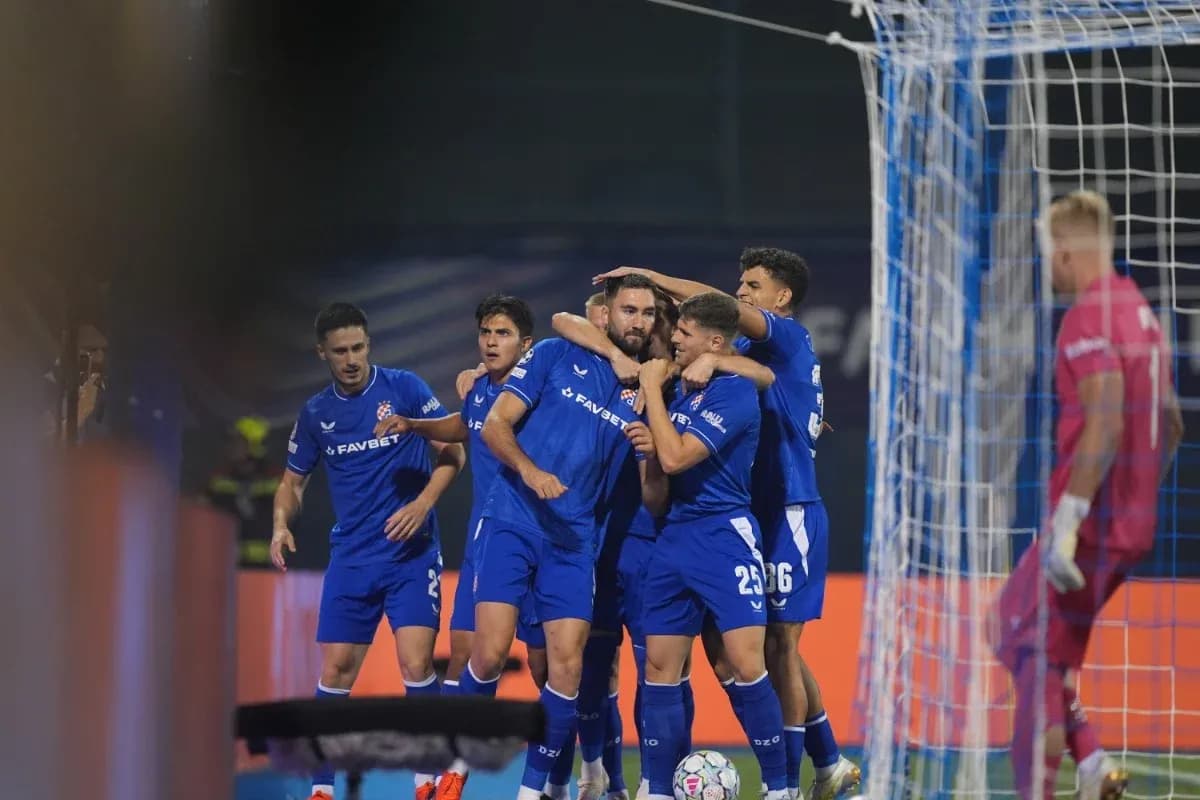
Dinamo Zagreb and Viking produced a tactically rich 2-2 draw at Stadion Maksimir in this UEFA Champions League Play-offs tie, a match defined by Dinamo’s territorial dominance against Viking’s ruthless efficiency in transition. The hosts led 2-0 inside ten minutes but were pegged back before half-time, and despite sustained pressure after the interval, they could not convert control into a decisive third goal.
Dinamo, set up by Mario Kovacevic in a 4-1-4-1, imposed themselves through structure and volume. With J. Misic anchoring as the single pivot, the home side built patiently from the back, using the full width of the back four and a high-positioned midfield line of M. Lisica, L. Stojkovic, M. Zajc and M. Orsic behind lone striker D. Beljo. Their 60% possession and 544 total passes, of which 438 were accurate (81%), underline a game plan built on circulation and positional play rather than chaos.
The early 2-0 lead reflected that design. Dinamo repeatedly found D. Beljo between the lines or running channels, with wide defenders—especially M. Perez Vinlof—stepping high to overload Viking’s flanks. The hosts generated 23 total shots, 17 from inside the box, and 7 were blocked, showing that they consistently reached advanced zones and forced Viking into last-ditch defending. However, only 4 of those efforts hit the target, a poor on-target conversion that ultimately cost them the win.
Out of possession, Dinamo’s 4-1-4-1 compressed into a 4-5-1, with the wide midfielders dropping to form a flat five. The relatively low foul count (12) suggests they preferred controlling space over constant duels, but Viking’s two goals highlighted a vulnerability: when the front line failed to press in unison, Viking could play through the first line and attack the channels behind the full-backs. The yellow card to Moris Valinčić for “Foul” on 83 minutes came in a phase where Dinamo were chasing a winner and pushing numbers high, exposing their defenders to more recovery challenges.
Kovacevic’s substitutions were all geared towards maintaining pressure and refreshing the attacking structure rather than changing the system. L. Kacavenda (IN) came on for M. Zajc (OUT) at 60', adding fresh legs and vertical running from midfield. At 68', R. Mudrazija (IN) replaced L. Stojkovic (OUT) and A. Hoxha (IN) came on for M. Lisica (OUT), a double move that injected energy into the central and wide lanes while keeping the 4-1-4-1 intact. Later, N. Galesic (IN) for M. Valincic (OUT) and S. Prevljak (IN) for M. Orsic (OUT) at 84' signalled a final push: more direct presence up front and a tweak in the back line to balance the risk of late counters.
For Viking, Bjarte Aarsheim’s 4-3-3 was far more pragmatic. With only 40% possession and 371 passes (272 accurate, 73%), Viking accepted long stretches without the ball, prioritising compactness and clear counter-attacking patterns. The midfield trio of T. Moi, Joe Bell and K. Askildsen focused on screening central lanes and forcing Dinamo wide. Their 10 fouls and just 1 yellow card (Joe Bell for “Foul” at 65') show a disciplined, controlled aggression rather than reckless defending.
Viking’s attacking output was minimal in volume—6 total shots, 5 inside the box, 3 on target—but extremely efficient. Their two first-half goals both came from quick, vertical sequences once they bypassed Dinamo’s first press, using the front three’s movement to attack the spaces behind Dinamo’s advanced full-backs. T. Moi was central to this pattern, providing both assists before being withdrawn on 58', with S. Kvia-Egeskog (IN) coming on for him (OUT) to add fresh energy in the same transitional role.
Defensively, Viking’s back four held a relatively deep line, inviting Dinamo to cross and shoot from congested areas. The fact that they conceded 23 shots but only 4 on target and recorded 0 blocked shots officially suggests that many of Dinamo’s efforts were rushed or off-balance rather than clean, set-piece-style blocks. The later substitutions—S. Bjorshol (IN) for H. Heggheim (OUT) and H. J. Haugen (IN) for K. Haugen (OUT) at 72', then J. Hansen (IN) for Z. Tripic (OUT) and R. Postema (IN) for P. Christiansen (OUT) at 87'—were clearly aimed at preserving legs in the back line and front press, protecting the draw while keeping a counter-attacking threat.
In goal, I. Nevistic (Dinamo Zagreb) made 1 save, reflecting Viking’s low shot volume but high finishing efficiency; he had little margin for error, and both conceded goals came from high-quality chances rather than speculative efforts. At the other end, A. Ostbo (Viking) produced 2 saves, and while that number is modest relative to Dinamo’s 23 shots, it underlines that many of the hosts’ attempts missed the target or were blocked before reaching him. His role was more about commanding the box and managing crosses and cutbacks than producing a string of spectacular stops.
Statistically, the draw feels like a classic contrast between control and efficiency. Dinamo’s dominance in possession, shot volume and corners (9-3) shows a side capable of pinning opponents back and creating repeated waves of pressure. Yet their inability to turn 17 shots inside the box into more than 2 goals exposes a finishing problem and perhaps a lack of variety in the final third patterns.
Viking, conversely, maximised limited possession. With just 6 shots and 3 on target, they converted two into goals and then managed the game smartly, rotating their defensive personnel to maintain concentration and physicality. Both teams finished with 1 yellow card each, reinforcing that this was more a tactical chess match than an overly physical contest.
From a broader lens, Dinamo Zagreb will feel they left an advantage on the table at Stadion Maksimir: structurally superior, technically cleaner, but not ruthless enough. Viking emerge encouraged; their compact 4-3-3, disciplined midfield, and sharp transitions proved sufficient to escape with a 2-2 draw that keeps the Play-offs tie finely balanced heading into the next leg.