.svg&w=384&q=75 "GoalGist logo")
Christos Tzolis: Arsenal's New Warrior
At Arsenal’s training base, they already have a name for him.
Leonidas.
In the film, the Spartan king drags a hopelessly outnumbered army into a fight they have no right to contest, relying on courage, will and an iron body to stretch the odds. At London Colney, that myth has been pinned to Christos Tzolis. The fitness coaches chose it. The new Greek winger has earned it.
Within a week of his £34m move from Club Brugge, Tzolis was leaving staff and teammates trailing in his wake in the pre-season testing. One particular running drill – more than a kilometre covered in punishing, broken intervals – turned into his personal stage. He topped the charts.
He smiles when the numbers come up. He won’t reveal the full data, just concedes they were “good”. The grin suggests they were a lot better than that.
From Norwich struggles to a reset in Germany
This is not the first time Tzolis has walked into the Premier League. The last time, he was a teenager dropped into a relegation fight he could not influence.
Norwich, 2021-22. Three league starts. A squad that finished bottom and never looked close to coping with the division’s demands. The following season brought only three Championship starts and a loan to Twente that fizzled out. The promise that once made him one of Europe’s most intriguing young forwards seemed to be slipping into the background.
So he left East Anglia again, this time for Fortuna Düsseldorf, and that is where the story turns.
“In football it’s not always going up. You can have some setbacks and difficulties,” Tzolis says. He talks calmly, without self-pity, as if he has replayed this chapter enough times to file it neatly away. Norwich, he insists, became a lesson rather than a scar.
“I learned a lot of things from this period at Norwich. That’s why I wanted to go to Düsseldorf to get the confidence back, because I knew I have the skills and qualities to score goals.
“Even though it was not the highest level, like playing in the Premier League, it’s good to play every game and have the feeling that you can score and create, and play good games. Then you go to the next level, which is Club Brugge, and I had two amazing years there because I made the decision to go to Düsseldorf and have the confidence.”
The logic is simple: play, score, create, feel important again. Germany’s second tier offered him rhythm and responsibility. Club Brugge then gave him a platform and a spotlight. Arsenal, the ultimate step, only came into view because he was willing to drop down and rebuild.
“I feel now more ready to be in the Premier League. For me, I did the right decision after Norwich. I developed myself, I improved a lot. I’m not the same player I was in Norwich, 100%. I feel it in my body and also in my mindset. Now it’s my time to show that I’m ready and capable of playing in the Premier League.”
The words are measured, but there is steel underneath. This is a player who knows exactly how far he has travelled.
Numbers that demanded attention
The statistics from Brugge back him up. Over two seasons he scored 33 goals, but it was last year that turned him from a revival story into a serious transfer target.
In 2025-26 he ripped through the Belgian Pro League: 17 goals, 23 assists, and a title reclaimed for Brugge. No one in the division came close to his output. His 40 goal involvements were 16 more than any other player in the league.
Those are not the figures of a confidence player in a comfort zone. They are the numbers of a winger who has learned how to dominate.
Life at Brugge, a club used to dictating games, suited his instincts. It could hardly have been more different from his first Premier League experience.
Norwich asked him to dig in, defend deep, chase transitions that rarely materialised. Arsenal will ask something else entirely.
“The team was not ready for the Premier League and that makes it also difficult for me to adapt and to play how I could play,” he says of that Norwich season. “I’m a more offensive player, and a player that plays for a team that has the ball and creates a lot of chances. With Norwich we had to defend more low and maybe to have some transition moments, but that was not working. Obviously the game time was not enough as a young player to develop and that was the bad thing of the Norwich situation.”
Now he joins the very club against whom he made his Premier League debut, walking out at the Emirates as a raw teenager in a struggling side. This time, the stadium is home.
Arteta’s message: don’t change
The call came while Tzolis was back in Thessaloniki, enjoying the summer in the city that shaped him. Arsenal wanted a replacement on the left flank for Leandro Trossard. His name was high on their list.
He spoke twice, at length, with Mikel Arteta. The message from the manager was strikingly simple: keep doing what you did in Belgium.
No reinvention. No caveats. Just bring the Brugge version of Christos Tzolis to north London.
“It’s always difficult to say no to Arsenal,” he says. “There were some teams that talked and asked, but not concrete. Arsenal was directly the most concrete team and that made it easier for me to lock in and to say: ‘I want just to go there, I don’t want to hear anything else.’ It was an easy choice.”
That clarity matters. For a player who once found himself squeezed out by circumstance and system, a coach telling him to lean into his strengths, not suppress them, is a powerful invitation.
A “left-pocket” finisher with a ruthless edge
Tzolis describes his ideal role with a phrase that will intrigue Arsenal supporters: a “left-pocket player who always went for goals”. It is how he remembers David Villa, the Spanish great he models his game on. Start wide, drift into the inside-left channel, and attack the goal with conviction.
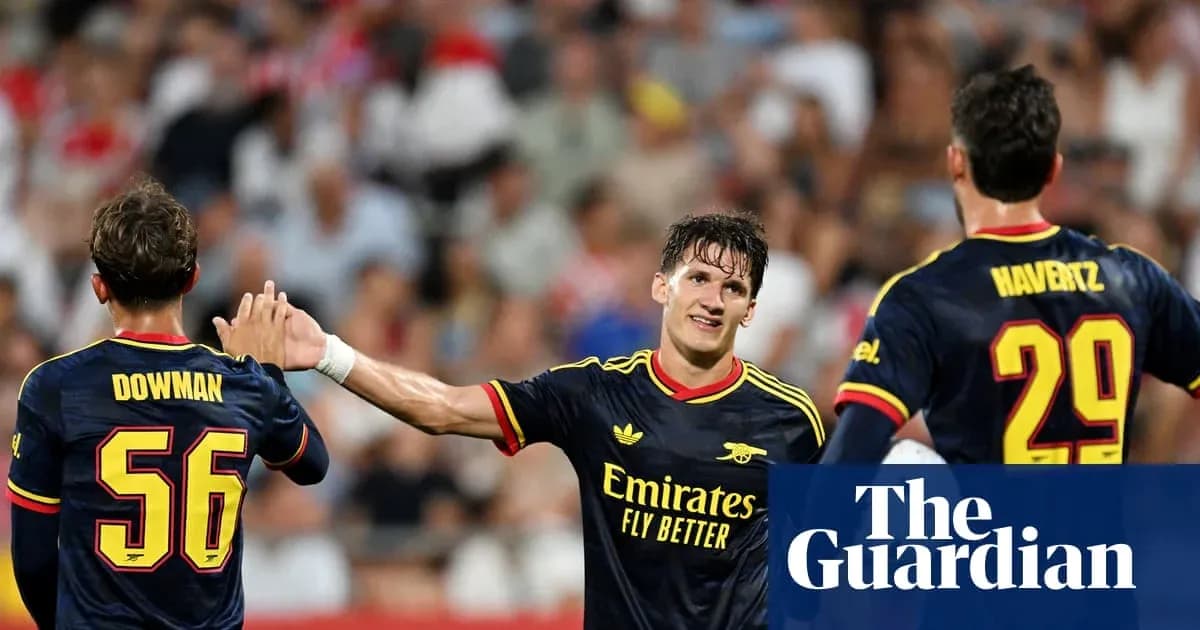
His first pre-season strike for Arsenal arrived exactly like that. In a 4-1 win over Girona on Saturday, he picked up the ball on the left, cut inside, and curled a finish inside the far post. The sort of goal that looks rehearsed because he has done it so many times.
He carries himself with the same directness. No grand declarations, no choreographed swagger, just a clear sense of what he brings.
Tzolis talks about “passion and desire to win”, about giving “100% for every game, every duel”. For a player nicknamed after a warrior king, the language fits.
Arsenal have signed him for his goals, his running power, his left-footed threat from that inside channel. But they may have gained something less tangible and just as valuable: a forward who has already fallen, rebuilt, and come back sharper.
Leonidas, they call him. The Premier League is about to find out whether the nickname sticks.

