.svg&w=384&q=75 "GoalGist logo")
Chelsea and Hull City Draw: A Clash of Two Styles
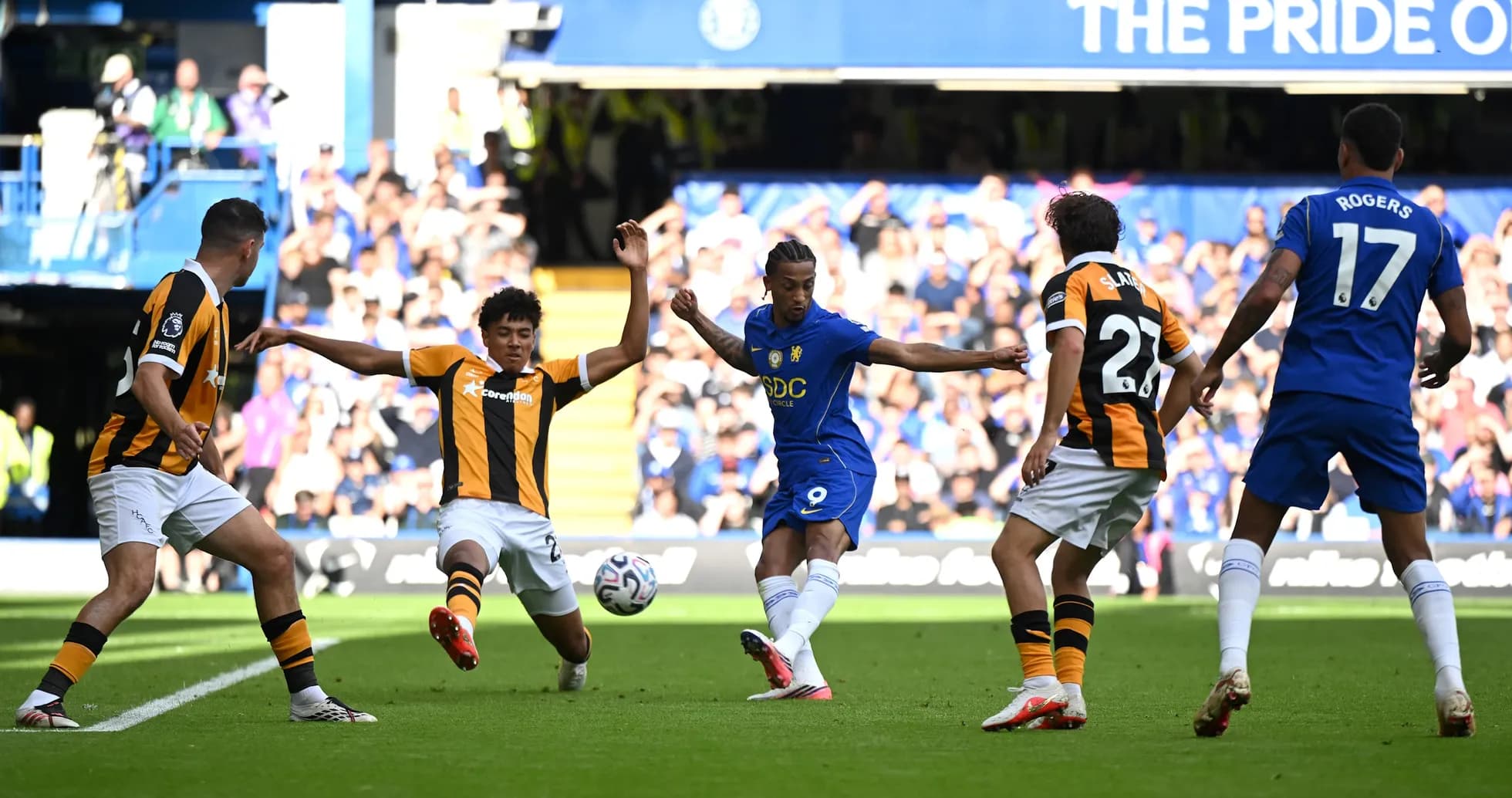
Stamford Bridge felt restless rather than celebratory as the final whistle went on a 2–2 draw that told two very different stories. For Chelsea, it was another wild, open contest that showcased attacking flair but underlined defensive fragility. For Hull City, it was proof that their compact, organised 5‑4‑1 can survive even the most chaotic of Premier League away days.
The Big Picture – Two identities colliding
This was Round “Regular Season - 4” of the Premier League, and the table framed the narrative. Following this result, Chelsea sit 5th with 7 points, their overall goal difference at +1, calculated from 10 goals scored and 9 conceded across 4 matches. Hull, meanwhile, leave London 3rd on 8 points, with an overall goal difference of +3 from 5 goals scored and only 2 conceded.
The numbers sharpen the contrast. At home, Chelsea have scored 6 and conceded 5 in just 2 matches, an average of 3.0 goals for and 2.5 against at Stamford Bridge. On their travels, Hull arrived having scored 3 and conceded 2 in 2 away games, averaging 1.5 goals for and 1.0 against. One side thrives in chaos; the other has built its early-season rise on control and clean sheets.
Xabi Alonso leaned into Chelsea’s attacking DNA with a 4‑2‑3‑1, pushing full-backs and wide midfielders high. Opposite him, S. Jakirović stayed loyal to Hull’s season-long 5‑4‑1, a shape they have used in all 4 league matches, trusting the structure that has already delivered 3 clean sheets overall.
Tactical Voids – The absences that shaped the game
Chelsea’s squad sheet carried some notable gaps in the spine. M. Caicedo, E. Emegha, J. Henderson and M. Palestra all missed the fixture through injury. The absence of Caicedo in particular left Alonso without his most natural ball-winner and tempo regulator at the base of midfield. In his place, R. Lavia had to shoulder more responsibility alongside R. James and M. Gusto in the central and half-space channels, often stepping into zones where Caicedo would normally screen transitions.
For Hull, the injury list was even longer: I. Ansah, J. Butland, D. Gyabi, C. Hughes, E. Matazo and H. Morita were all unavailable. That stripped Jakirović of rotational options in goal, midfield legs off the bench, and some of the depth that might have allowed Hull to be more aggressive late on. Instead, he doubled down on discipline and structure, trusting his starting XI to absorb long spells without the ball.
Disciplinary trends from the season added another layer. Chelsea’s yellow-card distribution skews to the bookends of games: 33.33% of their cautions have come between 0–15 minutes, and 22.22% between 76–90. That tendency towards early and late aggression – or desperation – mirrored the ebb and flow of this match, as Chelsea chased the game after a 1–2 half-time deficit.
Hull, by contrast, typically pick up their yellows in the grind of the second half: 30.77% between 46–60 minutes and 15.38% in both the 31–45 and 61–75 windows. That aligns with a side that tackles more intensely once protecting a lead or trying to slow momentum. Players like O. McBurnie and M. Crooks, both already on 2 yellow cards for the season, personify that edge. McBurnie’s physicality up front is both an outlet and a disciplinary risk, while Crooks’ 6 tackles and 2 blocks in limited minutes show a midfielder who lives on the line.
Key Matchups – Hunter vs Shield, and the engine room battle
The headline duel was always going to be Chelsea’s attacking trident against Hull’s back five.
The “Hunter vs Shield” dynamic centred on João Pedro, M. Rogers and C. Palmer against a Hull unit that had conceded just 2 goals overall heading into this game. João Pedro arrived as both a top scorer and top creator: 3 goals and 3 assists overall, with 8 shots (4 on target) and 7 key passes. He is not just a finisher but a reference point, winning 34 of 61 duels and drawing 12 fouls. In this 4‑2‑3‑1, his movement off the front line dragged Hull’s central defenders – S. Ajayi and J. Egan – into uncomfortable zones.
Alongside him, Rogers and Palmer brought different kinds of threat. Rogers, with 3 goals and 1 assist overall and 10 key passes, attacks the half-spaces with direct dribbling and vertical runs. Palmer, with 2 goals, 2 assists and 9 key passes, is the conductor between the lines, his 80% passing accuracy evidence of how often Chelsea’s attacks flow through his feet.
Hull’s shield was collective rather than individual. The back three of Ajayi, Egan and N. Mendy, flanked by L. Coyle and R. Giles, compressed the central corridor and forced Chelsea wide. Ahead of them, M. Crooks and R. Slater were tasked with disrupting Palmer’s rhythm, while M. Belloumi tracked back diligently from the right. Belloumi’s season numbers underline his two-way importance: 2 goals, 1 assist, but also 10 tackles, 3 blocks and 9 interceptions overall. In this match, his role was as much about helping Coyle double up on Pedro Neto and limiting Chelsea’s overloads on that flank.
The “engine room” contest was equally compelling. For Chelsea, Lavia and James had to balance progression with protection. Without Caicedo, their double pivot was more creative than destructive, which helped Chelsea sustain attacks but left them exposed when possession turned over. That vulnerability is consistent with their season: overall they average 2.5 goals scored but 2.3 conceded per game, and they have yet to keep a clean sheet at home.
Hull’s midfield, by contrast, is built to suffer. Crooks’ 6 tackles overall and willingness to commit fouls (5 this season) make him the enforcer, while Slater and E. Stroud shuttle to close passing lanes. Their job was not to outplay Chelsea’s technicians but to funnel them into predictable patterns that the back five could read.
Statistical Prognosis – A draw that fits the data
Following this result, the numbers still tell us who these teams are.
Chelsea’s overall record of 2 wins, 1 draw and 1 defeat, with 10 goals for and 9 against, confirms a side that lives on the edge. At home, their 6 goals scored and 5 conceded in 2 matches underline Stamford Bridge as a venue of high-event football. They have not failed to score once this season, and they have yet to keep a clean sheet anywhere.
Hull, meanwhile, extend an unbeaten overall start: 2 wins, 2 draws, 0 defeats, with 5 goals scored and just 2 conceded. On their travels, they remain defensively sound, with 3 goals for and 2 against in 2 away matches. Their reliance on a 5‑4‑1 in all 4 games speaks to a clear identity: stay compact, strike selectively, and trust the structure.
In xG terms – even without explicit figures – the profiles are clear. Chelsea’s volume of chances, driven by João Pedro, Palmer and Rogers, suggests they will continue to generate high expected goals, especially at home. But their defensive averages and lack of clean sheets hint at an xG against that is too generous for a side with top-four ambitions.
Hull’s defensive solidity, their three clean sheets overall and low goals-against averages suggest a side whose xG against is consistently suppressed by shape and discipline. The trade-off is a more modest attacking output – 1.3 goals per game overall – but in a league where margins matter, that stability travels well.
This 2–2 at Stamford Bridge, then, felt less like an anomaly and more like a crystallisation of both teams’ seasonal truths: Chelsea as the beautifully flawed aggressor, Hull as the quietly efficient disruptor. If the underlying trends hold, Chelsea’s campaign will hinge on tightening the spaces behind their attacking brilliance, while Hull’s will depend on whether their defensive machine can keep resisting nights like this, under the brightest lights, against the league’s most dangerous hunters.