.svg&w=384&q=75 "GoalGist logo")
Cagliari's Tactical Masterclass Against Atalanta: A 2-1 Victory
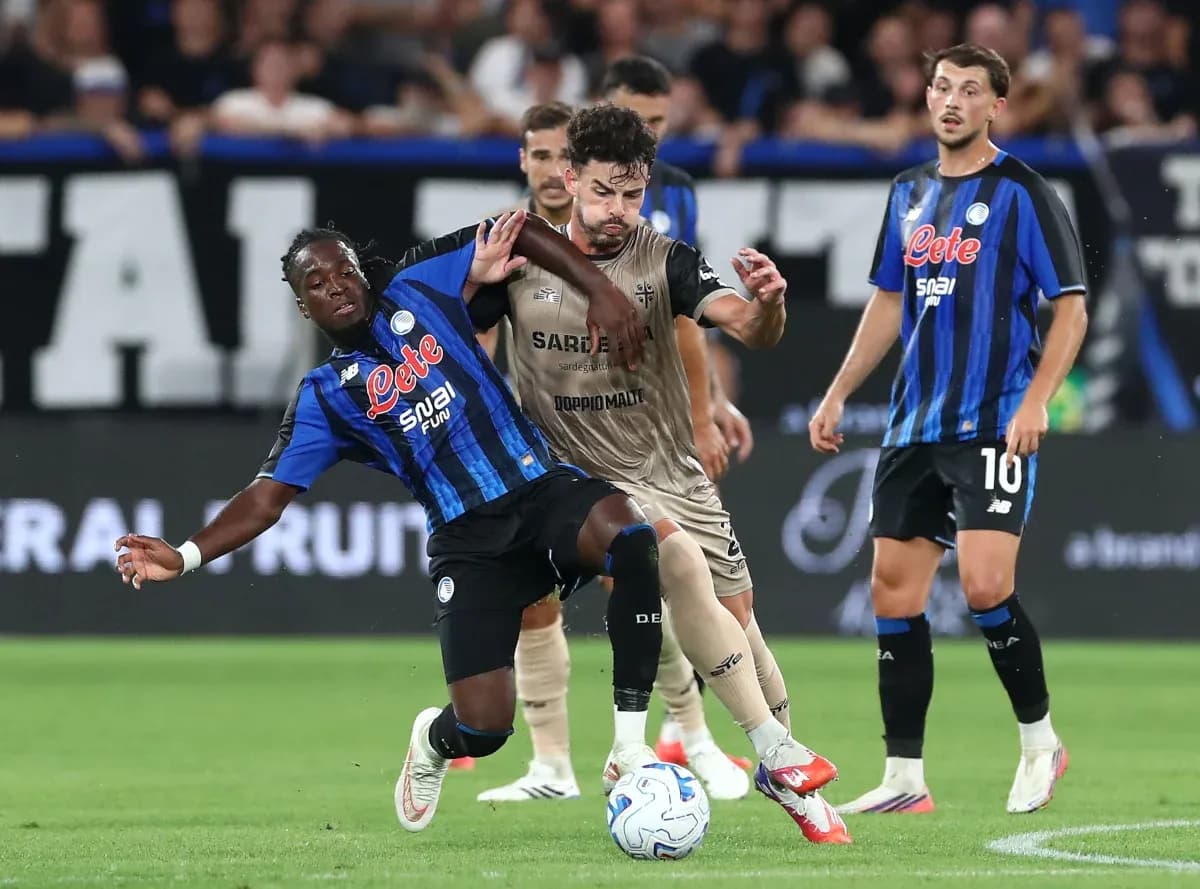
New Balance Arena closed under the Bergamo dusk with a scoreline that cut against the grain of expectation. Atalanta, in their familiar 4-3-3 under Maurizio Sarri, saw a 1-0 advantage dissolve into a 1-2 home defeat against a disciplined Cagliari side shaped by Fabio Pisacane’s 4-4-1-1. In a Serie A season still in its early chapters, this felt like a statement: Cagliari are not just efficient, they are structurally mature on their travels.
Pre-Match Numbers
Heading into this game, the numbers already hinted at a clash of identities. Overall, Atalanta had taken 6 points from 4 matches, with a goal difference of 0 from 5 scored and 5 conceded. At home they had been more assertive: 2 wins from 3, 4 goals for and 3 against, averaging 1.3 goals scored and 1.0 conceded per match. Cagliari arrived in Bergamo with 9 points from 4 games, fourth in the table, and a quietly impressive away record: 2 wins from 2 on their travels, 3 goals scored and just 1 conceded, averaging 1.5 goals for and 0.5 against away from home.
Tactical Analysis
That contrast framed the tactical story. Atalanta’s 4-3-3 was built to dominate territory and rhythm. M. Carnesecchi sat behind a back four of R. Bellanova, O. Kossounou, G. Scalvini and S. Kolasinac, a line designed for aggressive positioning rather than deep retreat. In front, the midfield trio of L. Samardzic, F. Kessie and Ederson carried the dual responsibility of progression and counter-pressing. Ahead of them, C. De Ketelaere and J. Rowe flanked G. Scamacca in a front three that was supposed to stretch Cagliari horizontally and pin their back line.
Instead, Cagliari’s structure quietly inverted the script. Pisacane’s 4-4-1-1, with E. Caprile in goal, a back four of J. Pedro, A. Deiola, J. Rodriguez and A. Obert, and a midfield band of M. Adopo, A. Romano, H. Winks and J. Fazzini, created a compact screen in front of their penalty area. D. Maldini operated between the lines behind P. Mendy, forming a flexible axis that could press Atalanta’s pivots or drop to form a 4-5-1.
Absentees
The absentees mattered. Atalanta were without G. Gaetano (suspended after a red card), I. Hien (muscle injury) and K. Sulemana (knee injury). Gaetano’s suspension was particularly significant: his season so far, with 1 red card and no penalties taken, had been defined by intensity and risk in midfield. Without his progressive passing and defensive bite, Sarri leaned more heavily on Kessie and Ederson to link phases and protect transitions. Hien’s absence removed another option for athletic cover in the back line.
Cagliari, for their part, travelled without M. Felici and R. Idrissi (both knee injuries), M. Nzola (lacking match fitness) and Y. Trepy (injury). The forward line, therefore, depended heavily on P. Mendy’s running and Maldini’s craft, but the spine remained intact. That continuity showed in their collective behaviour: they defended in layers, rarely breaking shape even when Atalanta managed to tilt the pitch.
Discipline and Card Profiles
Discipline and card profiles added another layer to the narrative. Over the season, Atalanta’s yellows had been concentrated late: 50.00% between minutes 61-75 and another 50.00% between 76-90, with a single red card coming in the 91-105 window. This pattern of late aggression and fatigue-induced fouls hinted at a team that sometimes chases games rather than controls them to the whistle. Cagliari’s bookings were more distributed, with 20.00% of their yellows in the opening 15 minutes, 40.00% between 46-60, 20.00% in 76-90 and 20.00% again in added time. They are willing to foul early to set the tone, then again just after the break when pressing triggers reset.
Individual Matchups
Within that framework, individual matchups told the story of the evening.
The “Hunter vs Shield” duel lived on the flanks and in the box. G. Scamacca, flanked by De Ketelaere and Rowe, repeatedly confronted a Cagliari defence anchored by Deiola and Rodriguez. Deiola’s season profile – 8 tackles, 4 interceptions and 4 successful blocks, with 2 yellow cards but no reds – translated on the night into an assertive, front-foot defender stepping out of the line to contest aerial balls and cut off wall passes into Scamacca’s feet. Behind him, Caprile’s calm presence fit neatly into an away side that, overall, had conceded just 2 goals in 4 league games, with a goal difference of +2 from 4 scored and 2 allowed.
In midfield, the “Engine Room” battle was delicately poised. For Atalanta, Kessie and Ederson were tasked with punching through Cagliari’s double pivot and wide shuttlers. For Cagliari, H. Winks and A. Romano formed the positional core, while M. Adopo quietly became the game’s metronome. Adopo’s season numbers – 148 passes at an 86% completion rate, 8 key passes, 2 assists and 2 shots, both on target – reflected a player who balances vertical risk with control. In Bergamo, his role was to turn Cagliari’s recoveries into measured counters, often using Maldini as the first vertical outlet.
Adopo’s creative profile intersected neatly with Atalanta’s defensive tendencies. With no detailed minute-by-minute goals data available, the broader pattern still matters: Atalanta had yet to keep more than 1 clean sheet overall, and away from their own box they were conceding 2.0 goals per match on their travels. That fragility in transition, combined with a high defensive line, offered exactly the kind of space Maldini and Mendy could exploit when Adopo or Winks released them early.
Bench Options
On the bench, the tactical options hinted at alternate storylines that never fully materialised. Atalanta’s ability to introduce G. Raspadori and N. Krstovic – the latter already on 1 league goal and 1 yellow card, with 5 shots and 3 on target – suggested a potential late-game surge. Krstovic’s willingness to attack the box and his 1 blocked shot this season point to a forward who can both finish and press from the front. Yet Cagliari’s compactness and game-state advantage after turning the match around meant the hosts were more often crossing into traffic than creating clean, high-value chances.
Cagliari’s bench, stocked with defensive reinforcements like Y. Mina, Y. Sugawara and G. Aurelio, plus midfield stabilisers such as R. Gagliardini, underlined Pisacane’s priority: protect the lead, preserve structure. With a team that has already kept 2 clean sheets overall and failed to score only once this season, the away side could afford to manage the tempo rather than chase additional goals.
Post-Match Prognosis
Following this result, the statistical prognosis for both squads diverges. Atalanta’s overall attacking average of 1.3 goals per match is serviceable, but mirrored by an identical 1.3 conceded. Their home numbers – 4 scored, 3 conceded – suggest they will continue to play high-variance football in Bergamo: entertaining, but vulnerable whenever the press is broken and late-game discipline is tested.
Cagliari, by contrast, look built for sustainability. Overall they average 1.0 goal scored and just 0.5 conceded per match, and on their travels that attacking figure rises to 1.5 while the defensive average remains at 0.5. Their penalty record is spotless so far: 1 taken, 1 scored, none missed. Combined with a flexible tactical identity – already using three different formations this season, including the 4-4-1-1 that succeeded here – they project as a side capable of grinding out results in hostile venues.
In narrative terms, this match felt like a clash between an Atalanta side still searching for balance without key figures such as Gaetano and Hien, and a Cagliari team that already knows exactly what it is. Unless Atalanta tighten their late-game discipline and shore up the spaces behind their midfield, nights like this at New Balance Arena may become an uncomfortable theme, especially against organised visitors who, like Pisacane’s men, are happy to let the ball belong to the home side while the result belongs to them.