.svg&w=384&q=75 "GoalGist logo")
Bodo/Glimt vs Union St. Gilloise: Tactical Analysis of 3-2 Extra-Time Victory
Bodo/Glimt’s 3-2 extra-time win over Union St. Gilloise at Aspmyra Stadion was above all a territorial siege versus a counter-punching, transition-heavy game plan, decided when the visitors finally broke under the cumulative pressure of 120 minutes.
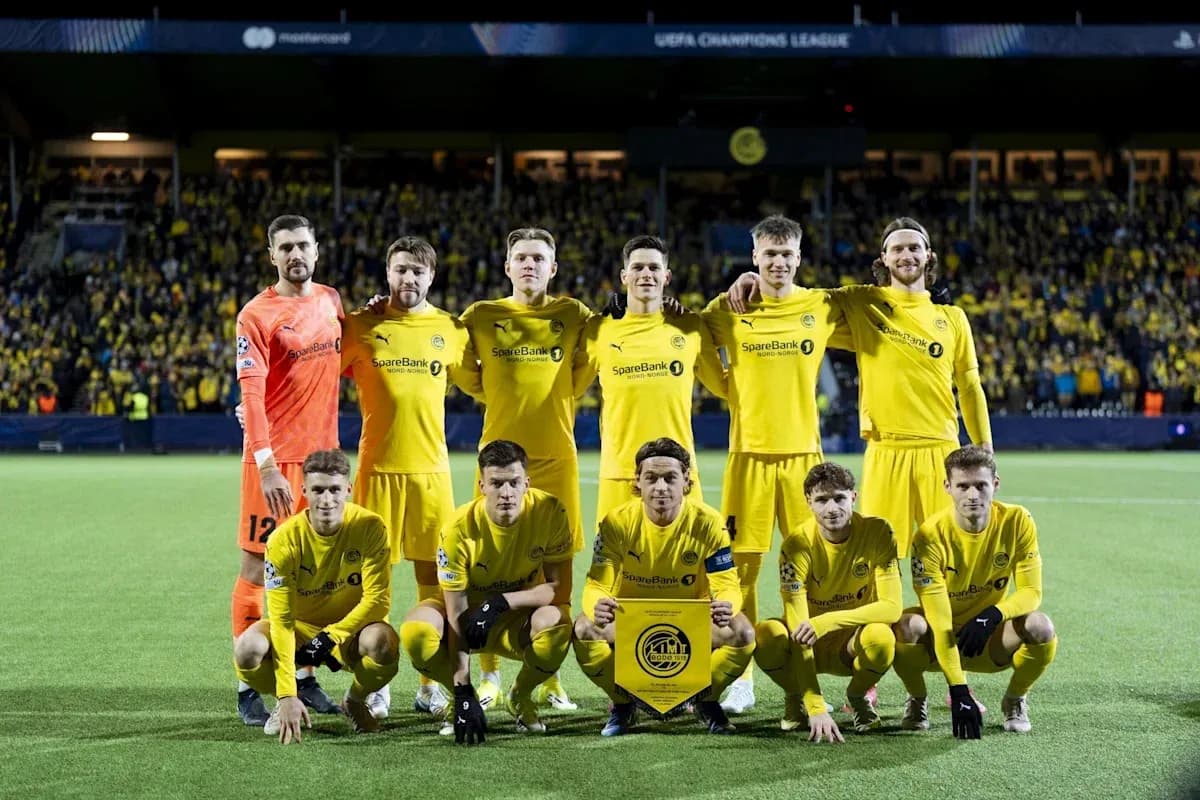
Structurally, Kjetil Knutsen kept Bodo/Glimt in a clear 4-3-3. The back four of F. Bjorkan, J. Gundersen, O. L. Bjortuft and F. Sjovold gave a wide, high starting point in possession, with the full-backs stepping early to pin Union’s wing-backs. In midfield, the trio of S. Auklend, P. Berg and S. Fet formed a classic Norwegian-style rotating triangle: Berg as the metronome in the central lane, Auklend more aggressive between the lines to the right, Fet balancing on the left. Ahead of them, the front three of O. Blomberg, O. Brynhildsen and J. Hauge constantly inverted, with Hauge especially influential as the primary connector from the left half-space.
The statistical profile underlines how completely Bodo/Glimt imposed their positional game. They finished with 70% possession and an enormous passing volume: 999 passes, 889 accurate at 89%. That volume wasn’t sterile circulation; it was used to create repeated entries into the final third, reflected in 23 total shots, 17 from inside the box and 9 on target. The 10 corner kicks further show how often they locked Union deep and forced clearances under pressure. The six blocked shots highlight Union’s last-ditch defending around the edge of the six-yard box and penalty spot.
Union St. Gilloise's Strategy
Union St. Gilloise, by contrast, leaned into their 3-5-2 as a low-to-mid block counter system. With N. Havenaar, M. Sylla and K. Mac Allister as the back three, they tried to stay compact horizontally, screening the central corridor and forcing Bodo/Glimt wide. The wing-backs, L. Patris on the right and Guilherme Smith on the left, were tasked with double duty: tucking in to form a back five without the ball, then springing forward as primary outlets in transition. Inside, K. Van De Perre, B. Zeneli and A. Zorgane (before his substitution) formed a narrow midfield screen, looking to intercept vertical passes into Berg and the inside forwards.
Despite having only 30% possession and completing 427 passes (335 accurate, 78%), Union still generated 19 shots, 15 inside the box and 5 on target. That profile is typical of a team that attacks in short, direct bursts: when they broke through the first line of Bodo/Glimt’s press, they committed numbers quickly and shot early, often from central areas. Their equaliser through Guilherme Smith and later goal from M. Fuseini both came in phases where the wing-backs and forwards exploited the space left by Bodo/Glimt’s aggressive full-backs.
Goalkeeping Duel
The goalkeeping duel was shaped by that asymmetry of game plans. N. Haikin (Bodo/Glimt) faced 5 shots on target and made 3 saves, which, in the context of a high defensive line and a lot of space behind, required good starting positions and decisiveness on through balls. His interventions helped prevent Union’s counters from completely flipping the tie. At the other end, V. Chambaere (Union St. Gilloise) was under siege: Bodo/Glimt produced 9 shots on target, and he recorded 5 saves. That combination indicates a busy night in which he delayed the inevitable more than once, but couldn’t fully stem the volume of high-quality chances created by the hosts’ structured possession.
Tactical Adjustments
Tactically, the key adjustments came through substitutions and how they rebalanced the attacking lines. Knutsen’s first change, H. Aleesami (IN) coming on for J. Gundersen (OUT) at 41', was a like-for-like at left centre-back but with a slightly more progressive passing profile, helping Bodo/Glimt sustain pressure from deeper positions. Later, the double change at 70' — J. Kitolano (IN) for S. Auklend (OUT) and A. Helmersen (IN) for O. Brynhildsen (OUT) — refreshed the central midfield legs and added a more penalty-box-oriented presence up front. Helmersen’s movement between Union’s centre-backs became decisive in extra time, culminating in his 117' winner.
Union’s substitutions were more reactive and aimed at preserving energy in a side doing far more defensive running. M. Fuseini (IN) for P. David (OUT) at 61' injected pace and verticality into the front line, which paid off with his late equaliser in normal time. Earlier, R. Schoofs (IN) for A. Zorgane (OUT) at 70' and M. Biondic (IN) for D. Olaru (OUT) at 74' were attempts to maintain midfield intensity and give fresh legs to chase counters. However, the red card sequence for Kamiel Van de Perre at 90+6' — a second yellow for Foul after an earlier booking for Foul — fundamentally altered Union’s ability to contest wide areas and step out of their block in extra time. Reduced to 10 men, their 3-5-2 effectively flattened into a 5-3-1, inviting even more pressure and limiting their counter-attacking outlets.
Disciplinary Numbers
The disciplinary numbers underline how hard Union had to work without the ball: 10 fouls, 4 yellow cards and 1 red, versus Bodo/Glimt’s 11 fouls and 2 yellow cards. Several of Union’s bookings — including those for Argument to Guilherme Smith at 90+6' and to Kevin Mac Allister at 117' — also speak to the psychological toll of defending for such long stretches and then seeing the tie slip away in extra time.
Final Analysis
In the final analysis, Bodo/Glimt’s tactical identity — high-possession 4-3-3, full-backs advanced, midfield rotations and a front three constantly attacking the half-spaces — was fully reflected in the statistical dominance: 70% possession, almost a thousand passes, more shots, more corners and more shots inside the box. Union St. Gilloise’s plan to absorb and counter was intermittently effective and produced two goals from limited ball share, but the red card and the sheer volume of defending eroded their structure. Over 120 minutes, the tactical balance tilted inexorably towards the side with the ball and the deeper bench, and Bodo/Glimt’s extra-time breakthrough was the logical outcome of that sustained, structured pressure.