.svg&w=384&q=75 "GoalGist logo")
Beşiktaş vs Hradec Králové: Tactical Analysis of a 1–0 Win
The 1–0 Beşiktaş win at Malsovicka arena was defined less by volume of chances and more by structure, control and game-state management, especially after going down to ten men. Hradec Králové’s 3-4-2-1 against Beşiktaş’s 4-1-4-1 produced a clear stylistic contrast: the hosts built through wing-backs and half-spaces, while the visitors relied on a disciplined back four, a single pivot and wide midfielders who could both press and carry transitions.
Hradec Králové’s shape placed three centre-backs behind a flat four across midfield, with V. Darida and S. Dancak as the central pair and J. Kucera and D. Horak operating as wing-backs. Ahead of them, M. van Buren and T. Sloncik supported O. Mihalik. This gave the hosts natural width and numbers in the second line, which helps explain their 8 corner kicks and 9 shots on goal. The structure was geared towards sustained pressure rather than quick breaks: wing-backs pushed high to pin Beşiktaş’s full-backs, while Darida tried to connect play vertically into the front three.
The early yellow card for Mick van Buren at 2' shaped his aggression in duels, but Hradec Králové still used him as a focal point to contest first balls and create space for Mihalik. When J. Kucera (OUT) was replaced by D. Ludvicek (IN) at 42', the right flank became slightly more conservative, with the substitute offering more defensive stability against Beşiktaş’s left side. After the break, S. Dancak (OUT) made way for M. Valenta (IN) and van Buren (OUT) for A. Umar (IN) in a double change on 59', signalling a push for fresh energy between the lines and renewed pressing intensity.
Statistically, Hradec Králové’s 48% possession with 10 fouls reflects a side willing to compete without the ball and commit to challenges to stop transitions. The 0 blocked shots underline that, while they found ways to test the Beşiktaş goal with 9 shots on target, they did not generate many heavily crowded shooting situations where efforts were smothered before reaching the keeper. Their inability to convert that volume into goals, despite territorial pressure and set-piece opportunities, was the core tactical failure: good occupation of zones, but insufficient final-third precision.
Beşiktaş’s 4-1-4-1 under Vincenzo Italiano was built on a solid defensive line of M. Murillo, T. Djalo, E. Topcu and K. Ouattara, screened by S. Ozcan as the single pivot. Ahead, a band of four — V. Cerny, J. Olaitan, O. Kokcu and I. Fakili — supported lone forward Oh Hyeon-Gyu. With 52% possession and only 6 fouls, Beşiktaş played a more controlled, less combative game in midfield, preferring to circulate the ball and look for gaps rather than engage in constant duels.
The visitors’ attacking profile is visible in their shot map profile: 5 shots on goal but 6 blocked shots. That combination indicates that while they didn’t pepper the target as frequently as Hradec Králové, they consistently reached promising zones where the hosts had to throw bodies in front of efforts. It also reflects a more patient approach, working the ball into congested areas rather than settling for speculative attempts.
The disciplinary sequence around Kassoum Ouattara was the tactical hinge. His yellow cards at 65' and 71', followed immediately by a red at 71', forced Beşiktaş into an emergency reconfiguration. Up to that point, Ouattara’s presence as a left-back in the back four had allowed the wide midfielders to push higher. Once reduced to ten men, Italiano used his substitutions at 76' — O. Kokcu (OUT) for W. Ndidi (IN), I. Fakili (OUT) for R. Yilmaz (IN), and V. Cerny (OUT) for S. Kilicsoy (IN) — to stiffen the spine and maintain a counter-attacking threat.
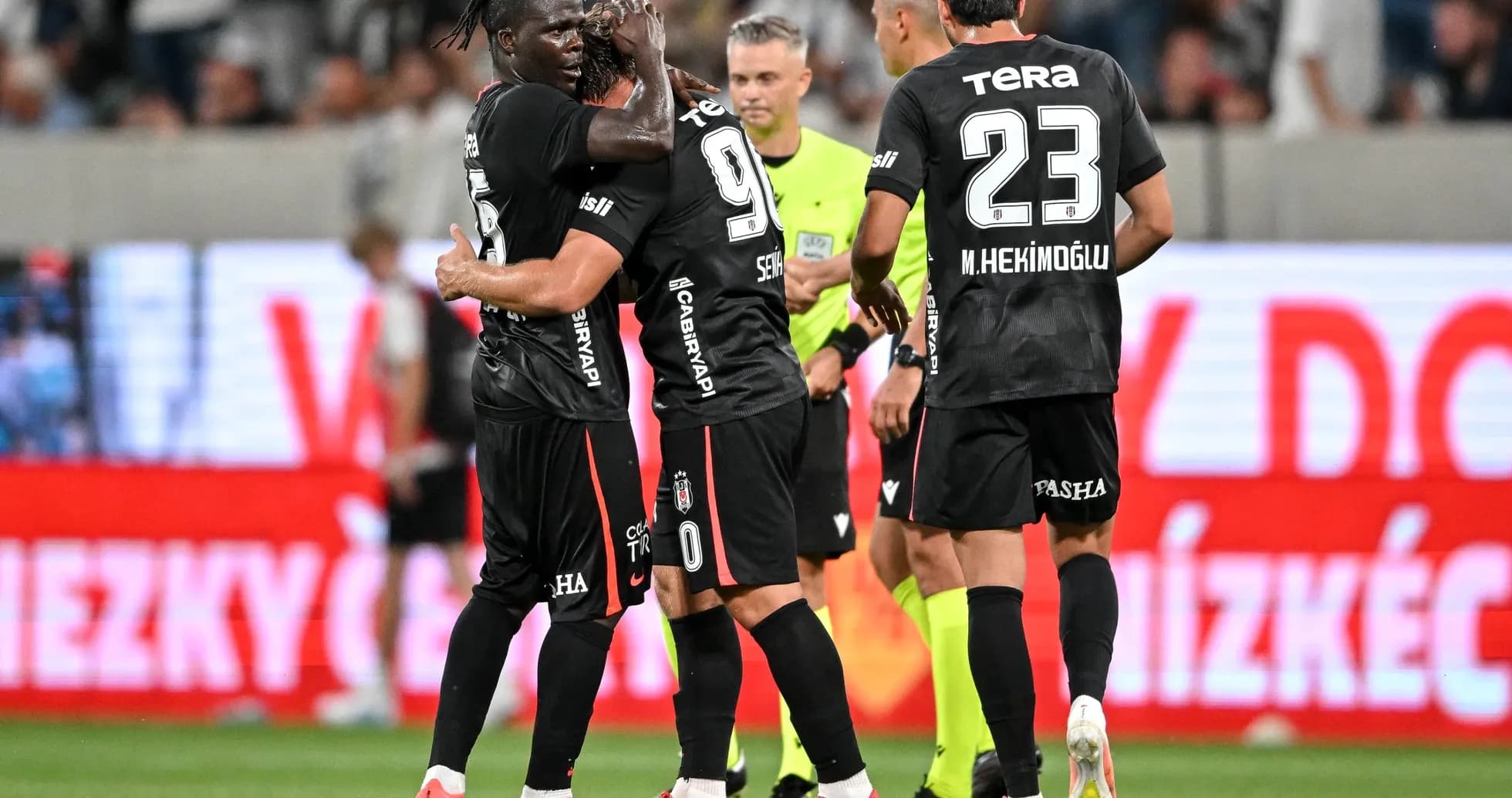
Ndidi’s introduction provided extra protection in front of the defence, effectively shifting Beşiktaş into a more compact, double-pivot structure out of possession, while R. Yilmaz gave fresh legs and defensive discipline on the flank. The key attacking adjustment was S. Kilicsoy, who not only replaced Cerny’s wide threat but became the decisive figure with the 80' goal. That strike, coming when Beşiktaş were a man down, illustrates how the visitors shifted from a possession-based 4-1-4-1 to a low-to-mid block with rapid, selective surges forward, trusting Kilicsoy and Oh to exploit any over-commitment by Hradec Králové.
After falling behind, Hradec Králové responded with T. Sloncik (OUT) replaced by D. Trubac (IN) at 81', seeking more creativity and fresh running between the lines. The hosts continued to push, reflected in their corner count and sustained attacking territory, but Beşiktaş managed the closing phase with further defensive substitutions: S. Ozcan (OUT) for E. Agbadou (IN) at 88', reinforcing the back line, and Oh Hyeon-Gyu (OUT) for M. Hekimoglu (IN) at 88', adding a fresh outlet to chase clearances and relieve pressure.
The card distribution — Hradec Králové 2 yellow cards, Beşiktaş 3 yellow cards and 1 red card — underscores the different defensive profiles. The hosts’ two cautions, for Mick van Buren and Jakub Uhrinčať, came early and were absorbed into their structure without forcing major tactical compromise. Beşiktaş, by contrast, had to completely re-balance their defensive block after Ouattara’s dismissal, narrowing their full-backs and relying heavily on central compactness and work-rate from the midfield line.
In pure statistical terms, Hradec Králové’s superior shots on goal and corner tally suggest they did enough in volume to take something from the match. But Beşiktaş’s marginal possession edge, significantly lower foul count, and higher number of blocked shots point to a side that defended in a more coordinated, anticipatory manner and chose their attacking moments more selectively. The decisive tactical story is of a visiting team that, even when reduced to ten, adapted its structure intelligently and maximised the impact of its substitutions, while the home side, for all their territorial pressure and set-piece volume, could not convert structural promise into a breakthrough.