.svg&w=384&q=75 "GoalGist logo")
Beşiktaş Dominates Midtjylland in UEFA Europa League Qualifier
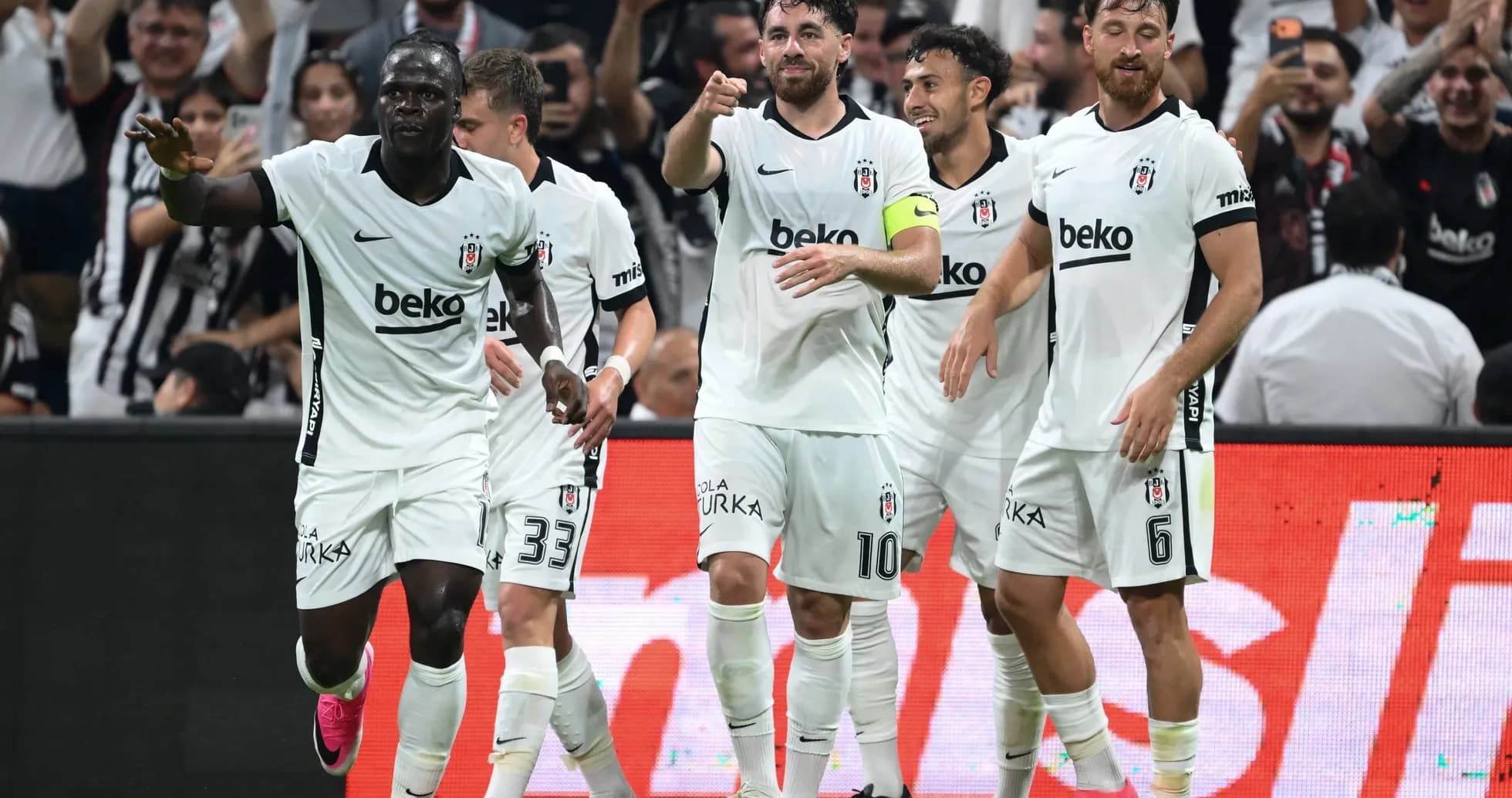
FC Midtjylland’s 0-2 home defeat to Beşiktaş at MCH Arena in the UEFA Europa League 2nd Qualifying Round unfolded as a classic example of how game-state and discipline can overturn an otherwise balanced tactical contest. With no shot, possession or passing data available, the structure of the lineups, the timing of the red card and the substitution patterns provide the clearest window into how Vincenzo Italiano’s side gained control after the interval.
Midtjylland started in a 4-3-3 under Mike Tullberg, with E. Olafsson in goal and a back four of R. Kristensen, M. Erlić, M. B. Sørensen and D. Castillo. In front, a three-man midfield of P. Billing, P. Bravo and V. Byskov supported an attacking line of D. Osorio, Cho Gue-Sung and Franculino. On paper, this is a vertically capable 4-3-3: Billing as the advanced runner, Bravo and Byskov able to connect short, and two wide forwards who can roll inside to free Kristensen and Castillo on the overlap.
Beşiktaş, by contrast, were clearly set up to control central spaces and manage transitions with a 4-1-4-1. A. Nübel started in goal behind a back four of M. Murillo, T. Djaló, E. Topcu and R. Yılmaz. S. Özcan anchored as the single pivot, with a line of four attacking midfielders – V. Černý, J. Olaitan, O. Kökçü and I. Fakili – supporting lone striker Oh Hyeon-Gyu. The structure is naturally compact: Özcan screening between the lines, Kökçü and Olaitan able to step inside to overload Billing and Bravo, while Černý and Fakili could either hold width or tuck in to form a box midfield.
First Half
The first half, reflected in a 0-0 half-time score, was shaped by Midtjylland’s attempts to progress via their full-backs and interior midfielders, and Beşiktaş’s willingness to absorb and counter. The early yellow card for M. B. Sørensen at 35' for “Handling” hinted at a back line under pressure and occasionally forced into emergency defending. More tellingly, M. Erlić’s first booking at 44' for “Roughing” suggested Beşiktaş were already finding ways to turn Midtjylland’s defensive line and force individual duels in the channels.
Tactical Changes
The match’s tactical hinge came at 53'. Erlić, already on a yellow, was booked again for “Tripping” and immediately shown a red card. That sequence did not just reduce Midtjylland to ten men; it also dismantled the structural integrity of their 4-3-3. With a centre-back dismissed, Tullberg had to re-balance the back line and sacrifice attacking threat. The triple substitution at 57' – Lee Han-Beom (IN) for Franculino (OUT), K. Watjen (IN) for P. Billing (OUT), and J. Emefile (IN) for V. Byskov (OUT) – underlined this shift.
Those changes effectively converted Midtjylland into a more conservative, safety-first shape. Lee Han-Beom’s introduction for a forward allowed the back four to be restored numerically, but at the cost of one of the front three. Removing Billing and Byskov for Watjen and Emefile likely aimed to add fresh legs and perhaps more discipline in midfield, but it also stripped the side of one of its key late-arriving runners (Billing) and a connective interior (Byskov). From that point, Cho Gue-Sung and the remaining advanced players were increasingly isolated, with less support between the lines and fewer wide overloads.
Beşiktaş, sensing the advantage, adjusted with intelligence rather than panic. At 56', V. Černý was booked for “Unsportsmanlike conduct”, but tactically he continued to operate as a key outlet until his substitution. The double switch at 69' – M. Rashica (IN) for Černý (OUT) – was decisive. Italiano replaced a hard-running wide midfielder with a more direct, goal-oriented winger at precisely the moment when Midtjylland’s ten men were beginning to tire from constant lateral shifting.
Within one minute, the new dynamic paid off. At 70', Rashica scored the opener, assisted by J. Olaitan. From a structural point of view, this was the logical outcome of Beşiktaş’s 4-1-4-1 against a reshaped, numerically stressed Midtjylland defence: the visitors could now circulate the ball through Özcan, draw Midtjylland’s compact block from side to side, and exploit the inevitable late-arriving gaps around the box. Olaitan’s assist underlines how the interior midfielders in Italiano’s system are encouraged to drive at the back line or slip runners into space once the pivot has drawn out the first line of pressure.
At 69', on the home side, S. Iheanacho (IN) for D. Castillo (OUT) further signalled Tullberg’s attempt to refresh wide areas, but the pattern of play had already shifted in Beşiktaş’s favour. The second goal at 76', a penalty converted by O. Kökçü, effectively killed the tie’s tactical balance. A 0-2 deficit with ten men forced Midtjylland into a dilemma: chase the game and risk a heavier loss, or sit in and limit damage. The subsequent substitution at 77', with S. Johannesen (IN) for D. Osorio (OUT), suggested a tilt towards energy and perhaps more direct running, but the structural handicap remained.
Game Management
Italiano then moved into game-management mode. At 79', A. Hadziahmetovic (IN) for J. Olaitan (OUT) added fresh legs and defensive stability in midfield, allowing Beşiktaş to protect central zones and shield the back four. The triple change at 85' – T. Bulut (IN) for M. Murillo (OUT), Y. Özcan (IN) for I. Fakili (OUT), and M. Hekimoğlu (IN) for Oh Hyeon-Gyu (OUT) – was a classic closing pattern: rotate full-back and wide roles to maintain intensity in pressing lanes, and introduce a fresh centre-forward to chase long balls and press the first pass out from the Midtjylland back line.
Discipline and Tactical Role
Discipline played a central tactical role. Midtjylland accumulated four yellows and one red: M. B. Sørensen (35' “Handling”), Erlić’s two bookings at 44' and 53' (both “Roughing” and “Tripping” leading to the red), and R. Kristensen at 75' for “Roughing”. Each card to a defender constrained their aggression in duels, particularly after the dismissal, forcing them to defend deeper and narrower. Beşiktaş’s three yellows – Černý (56' “Unsportsmanlike conduct”), Oh Hyeon-Gyu (81' “Tripping”), and Y. Özcan (86' “Roughing”) – were spread across lines and did not fundamentally alter their structure, especially as two of those players were substituted soon after or were late-game bookings in a controlled scoreline.
From a statistical perspective, the absence of concrete figures on shots, possession, passes, xG or saves limits quantitative analysis. What is clear, however, is that Beşiktaş managed the game-state with greater clarity once they had the numerical advantage. Midtjylland’s red card, combined with the necessary defensive reshuffle and sacrifice of attacking profiles, left them unable to sustain pressure or create a late surge. Beşiktaş, even without visible possession numbers, used their 4-1-4-1 to compress central spaces, progressively tilt the field after the break, and then close the match down efficiently once 2-0 ahead. In a tie defined by structure and discipline rather than open statistical dominance, Italiano’s side showed the sharper tactical adaptability.