.svg&w=384&q=75 "GoalGist logo")
Benfica’s Tactical Domination Over Aarhus in UEFA Europa League
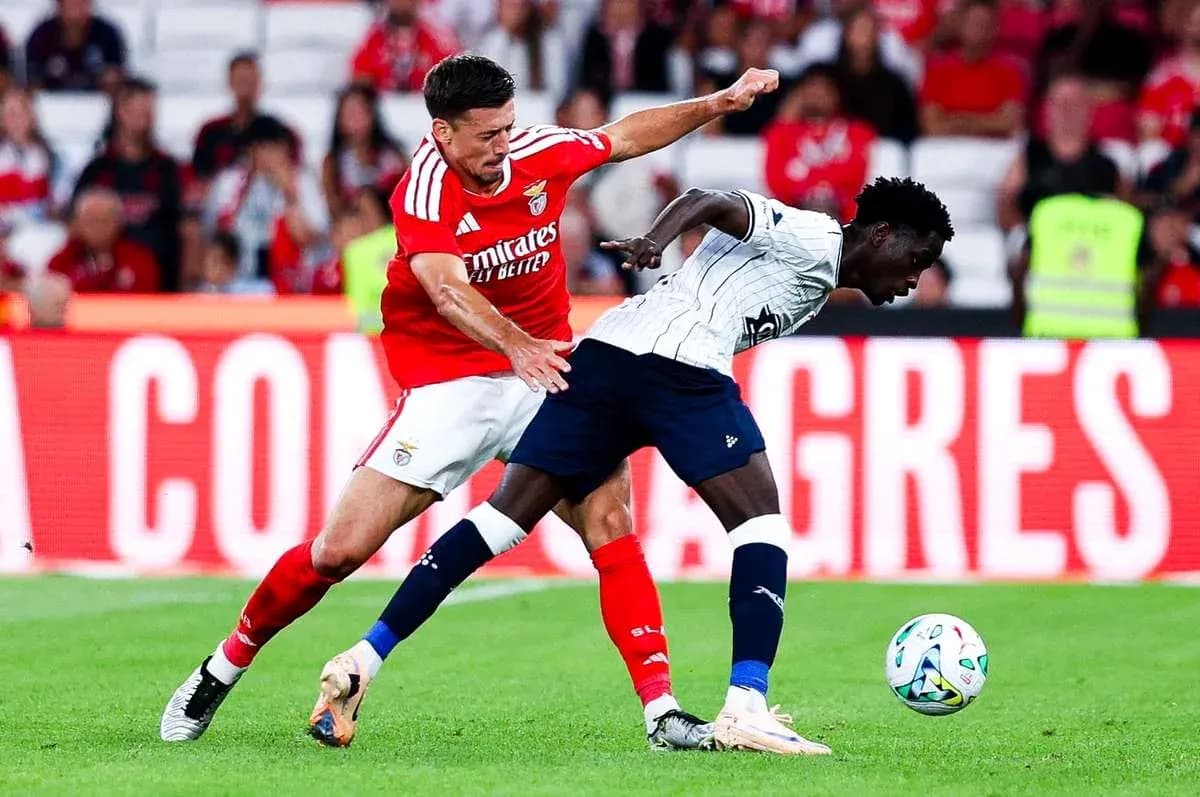
Benfica’s 3-1 win over Aarhus at Estádio da Luz was a tactical domination built on structural superiority, territorial control and a relentless attacking rhythm. In a UEFA Europa League Play-offs tie that was effectively decided by half-time, Marco Silva’s 4-1-3-2 imposed itself on Jakob Poulsen’s 3-5-2, pinning Aarhus deep and turning long spells of possession into sustained pressure rather than sterile circulation.
The statistical profile underlines the tactical story. Benfica finished with 71% possession to Aarhus’ 29%, and a 13–1 advantage in shots on goal. Even without total shots and xG values, the distribution of key metrics is clear: Benfica added 8 shots off target and an extraordinary 11 blocked efforts, while Aarhus managed only 1 shot off goal and 1 blocked shot. The hosts’ 11 corner kicks to Aarhus’ single corner show how consistently Benfica kept play in the final third, forcing the Danish side to defend their box for long stretches.
Benfica's Formation
Silva’s 4-1-3-2 was built on Leandro Barreiro as the single pivot in front of a back four of A. Bah, C. Lenglet, Tomás Araújo and S. Dahl. Barreiro’s role was pivotal in both phases: he anchored rest defence against Aarhus’ front two and provided the first vertical pass to launch attacks. Ahead of him, the narrow line of G. Sudakov, E. Barrenechea and G. Prestianni, with Rafa Silva drifting inside from a nominal second-striker/attacking-midfield role next to Vangelis Pavlidis, created constant overloads between the lines. This shape allowed Benfica to flood the central corridor with four and often five players, forcing Aarhus’ midfield line of J. Andersen, S. Jorgensen, K. Arnstad and M. Knudsen to collapse centrally and concede the wide zones to Bah and Dahl.
Aarhus' Formation
Aarhus’ 3-5-2, with M. Hedenstad in goal behind a back three of C. Rosler, M. Camara and E. Kahl, was set up to be compact and reactive. The wing-backs Andersen and Knudsen were meant to provide width in transition, while S. Jorgensen and K. Arnstad supported the front pairing of F. Emmery and T. Bech (with J. Bogere also starting high). In practice, however, the back five was constantly pushed onto the edge of their own area. With only 29% of the ball and just 1 corner, Aarhus rarely escaped the press long enough to build structured attacks; their lone goal from S. Jorgensen, assisted by Andersen, came from one of the few moments when they could connect centrally and exploit a brief lapse in Benfica’s rest defence.
Benfica’s pressing scheme was aggressive but controlled. With two forwards, they could press Aarhus’ outside centre-backs while using Sudakov and Prestianni to jump onto the wing-backs, funneling Aarhus into central traps where Barreiro and Barrenechea could counter-press. The foul count (Benfica 10, Aarhus 17) reflects how often Aarhus were late into duels as they tried to disrupt Benfica’s rhythm or halt counters after losing the ball deep.
First Half Analysis
The first half encapsulated the tactical imbalance. Early, Rafa Silva’s opener at 2' came from Benfica’s ability to get immediate depth and presence in the box; Aarhus’ back three were forced to defend facing their own goal, with little midfield screening. Barreiro’s own goal at 31' highlighted his two-way influence: stepping higher when Benfica locked Aarhus in, he was free to arrive at the edge of the area and attack second balls. Even when Aarhus pulled one back through S. Jorgensen at 36', the pattern did not materially shift. Benfica’s penalty for V. Pavlidis, confirmed by VAR at 45+1' and converted at 45', was the natural consequence of repeated entries into the box and Aarhus’ desperate defending.
Second Half Changes
In the second half, the game state allowed Silva to manage energy and personnel without compromising control. Substitutions were largely like-for-like: R. Rios (IN) came on for L. Barreiro (OUT) at 66', J. Duran (IN) for V. Pavlidis (OUT) at 72', and A. Schjelderup (IN) for G. Prestianni (OUT) at 72', with F. Aursnes (IN) replacing G. Sudakov (OUT) and J. Kaminski (IN) replacing Rafa Silva (OUT) at 84'. The structure remained a 4-1-3-2/4-2-3-1 hybrid, with fresh legs to maintain the press and possession dominance.
Poulsen’s changes were more reactive and aimed at damage limitation and energy injection. R. Carstensen (IN) came on for C. Rosler (OUT) and S. Tchamche (IN) for S. Jorgensen (OUT) in a double change at 57', suggesting an attempt to add running power and perhaps a more direct outlet. Later, J. Jonsson (IN) replaced M. Knudsen (OUT) and G. Links (IN) replaced F. Emmery (OUT) at 73', then M. Anderson (IN) came on for J. Bogere (OUT) at 81'. Despite these moves, Aarhus never altered the fundamental dynamic: they remained pinned back, with their forwards isolated and their midfield unable to progress the ball.
Discipline and Shot Data
Discipline-wise, Benfica collected two yellow cards (Barreiro at 9', Tomás Araújo at 24'), while Aarhus saw S. Tchamche booked at 83'. With no additionalInfo fields provided, the reasons cannot be specified, but the distribution aligns with the match picture: Aarhus committing more fouls overall (17) as they scrambled to contain Benfica’s rotations and late runs.
Without explicit goalkeeper statistics, the shot data still allows a clear inference of territorial dominance. Benfica’s 13 shots on goal, 8 off target and 11 blocked attempts indicate a side repeatedly entering shooting zones and forcing last-ditch interventions. Aarhus’ 1 shot on goal, 1 off target and 1 blocked effort show how rarely they could move their attacking structure into Benfica’s third. The 11–1 corner differential reinforces that this was not a contest of equals in either territory or chance volume.
From a broader tactical lens, Benfica’s performance at Estádio da Luz was a textbook example of how a possession-heavy side can translate control into real threat: high volume of shots on goal, multiple blocked efforts from sustained pressure, and a scoreline that mirrored the underlying dominance. Aarhus’ 3-5-2 never found a stable out-ball or pressing trigger to disrupt Benfica’s build-up, leaving them chasing shadows for most of the 90 minutes and relying on isolated moments rather than a coherent attacking plan.