.svg&w=384&q=75 "GoalGist logo")
Bayern Munich Triumphs: Neuer's Dilemma and Brown's Breakthrough
Bayern Munich have their first trophy of the 2026/27 season – and a few fresh talking points to go with it. A 2-1 win over Borussia Dortmund in the Franz Beckenbauer Supercup at a restless Signal Iduna Park brought goals from Nathaniel Brown and Michael Olise, a late Fabio Silva response and a night that felt far more serious than a “curtain-raiser”.
It also brought four clear storylines.
Neuer: still world class, still walking the tightrope
Risk has always been Manuel Neuer’s stage. It made him a revolutionary, the prototype for the modern goalkeeper. It also now makes him a recurring source of anxiety for Bayern.
The pattern is familiar. With the ball at his feet, Neuer can slice open a press and launch an attack. But the number of times he invites trouble is growing.
Everyone remembers the gift to Arda Güler at the Bernabéu in April, the pass that handed Real Madrid an early Champions League lifeline. In Dortmund, the theme resurfaced.
After 15 minutes, he tried to play out to Min-jae Kim and got it wrong. The pass was loose, Dortmund pounced, and only Kim’s sharp recovery prevented a clear chance and a fresh round of inquests.
Late on, Neuer turned a routine situation into a heart-stopper. Kim rolled a simple back-pass towards him, he tried to let Jobe Bellingham run past with a feint behind his standing leg, misjudged it and suddenly the Dortmund youngster was staring at the ball and the equaliser. Neuer had to fling himself into a desperate dive at Bellingham’s feet to rescue the situation he had created.
The reflexes are still outrageous. On the line, he remains elite. Early in the second half, Konstantinos Karetsas seemed certain to score from close range; Neuer’s reaction save was the kind that has defined his career.
But he is 38, openly hinting this could be his last season, and Bayern have already lined up Jonas Urbig as the heir. The plan is clear: Neuer for the biggest nights, Urbig gradually phased in. Performances like this, though – brilliance on the line, nerves in build-up – sharpen the question that will hang over the season: at what point do Bayern trust the future in the biggest games as well?
Brown the surprise No. 10 – and Bayern’s new joker
Nathaniel Brown arrived in Munich as a left-back. He left Dortmund with his first Bayern trophy and a statement performance in a completely different role.
With Jamal Musiala absent as he deals with a neurological dysfunction that has already forced him off in pre-season games against Leipzig and Heidenheim, and new signing Ismael Saibari not yet ready to start, many expected Tom Bischof to slot in behind Harry Kane.
Vincent Kompany had other ideas. Brown started as the No. 10.
It looked bold on the teamsheet. On the pitch, it made sense. Kompany later explained that in his system, the spaces a full-back occupies often mirror those of a playmaker between the lines. Brown, he said, is “unbelievably good between the spaces”, and this time Bayern needed that intelligence centrally because Serge Gnabry, Lennart Karl and Musiala were all missing.
Brown’s performance was not flawless – how could it be, in a new role and after only a few weeks at the club? Some combinations didn’t quite click, some movements were half a beat off. But he read the game well, linked play and, crucially, broke it open.
His opener in the 28th minute was the defining moment of his night, the strike that put Bayern in control and set him on the path to his first piece of silverware with the club. For a player signed as a full-back, to decide a Supercup as a No. 10 underlines exactly why Bayern wanted him: he gives Kompany another card to play when injuries bite or tactical tweaks are needed.
He is not alone. Konrad Laimer can flip from either full-back spot into the No. 6, No. 8 or even No. 10 role. Josip Stanisic can operate on both sides and step inside to centre-back. This is not just depth; it is elastic depth. Brown’s night in the hole showed how dangerous that can make Bayern across a long season.
Kovac’s inverted wing-backs: promise and problems
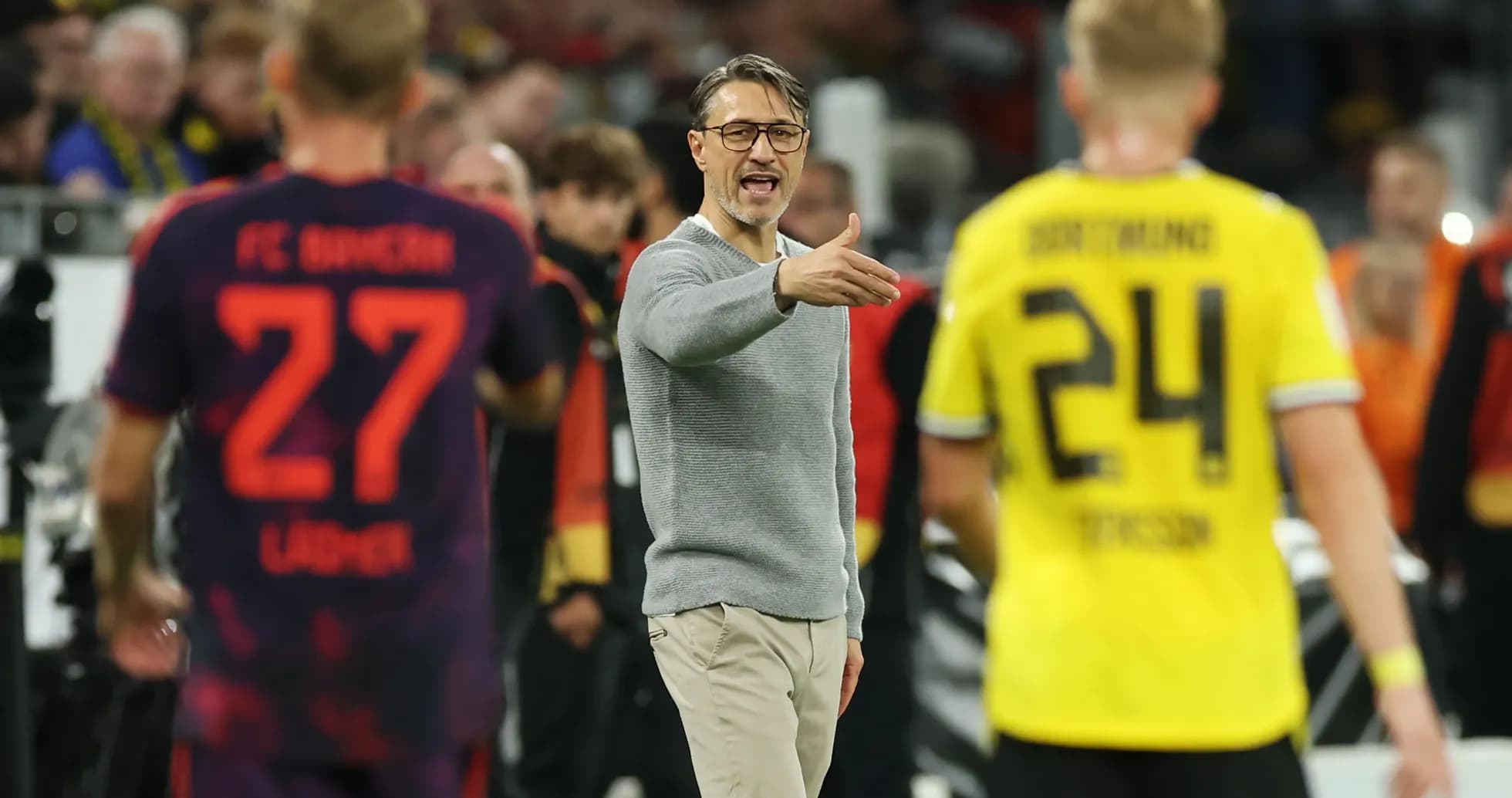
On the other bench, Niko Kovac used the Supercup as a live test lab.
He stuck with a pre-season experiment from the first whistle: left-footed Daniel Svensson at right wing-back, right-footed Julian Ryerson on the left. The idea is clear enough. Instead of hugging the touchline and swinging in crosses on their natural side, the wing-backs can drive inside, mirror top-level wingers and either combine centrally or shoot.
Against Bayern, the concept flashed both upside and downside.
Ryerson almost made it pay in the first half. Drifting into the left half-space, he bent a dangerous cross with his stronger right foot towards the far post. Ramy Bensebaini flicked it in with the slightest touch of his hair. The stadium roared. The flag went up. Offside, narrowly.
The structure also created one of Dortmund’s best openings before the break. Bensebaini drilled a low ball across from the left, Svensson – coming in from the right – arrived near the penalty spot. But the Swede had to swing with his weaker right foot, the body shape was wrong, the timing off. He kicked at air. In that exact zone, Ryerson on his natural right foot would have fancied it.
Kovac saw enough. At half-time he flipped them back: Ryerson to the right, Svensson to the left. The effect was immediate. Dortmund pushed higher, attacked the flanks with more conviction and started to get in behind.
The 2-1 goal came from exactly that pattern. Svensson, now back on the left, surged to the byline and cut the ball back perfectly for Fabio Silva to finish. It was the kind of move that becomes far rarer when the wing-backs are inverted.
Kovac’s tweak clearly gives Dortmund extra ways to hurt opponents, especially when they want their wide players to threaten inside. It also blunts some of their most natural wide patterns. The Supercup showed both sides of the coin – and underlined that this is not an experiment without cost.
Silva’s sharp response in a clouded future
Serhou Guirassy’s summer has gone quiet. The rumours have cooled, the exit talk has faded, and for now he looks set to stay at Dortmund.
On the pitch, the problems from last season remain. Against Bayern, Guirassy ran, pressed, battled. He never really got into the game. No shots of note, no real penalty-box menace.
Just past the hour, Kovac made the change. Guirassy off, Fabio Silva on, in search of more spark around the area.
Silva delivered.
His movement for Dortmund’s goal was exactly what had been missing. He dropped off the line at the right moment, lost his marker, then burst into the space Svensson created with that cut-back from the left. One touch, ruthless finish. 2-1 and belief surged around the stadium.
It was not an isolated cameo. The Portuguese forward had already shown flashes in his first year at BVB, hints that there is a more complete striker in there. This time, on a big stage, he turned hints into impact.
Now comes the complication. Several clubs are tracking him, with Betis Sevilla recently viewed as particularly keen. Silva himself is reportedly not committed to staying, and Dortmund’s hierarchy would be open to a sale if a suitable offer landed.
His goal against Bayern doesn’t change the financial reality. It does change the sporting calculation. With the transfer window deep into its final stretch, BVB must weigh up whether they can afford to lose a striker who looks ready to push for more minutes – and whether there is still time to find anyone better.