.svg&w=384&q=75 "GoalGist logo")
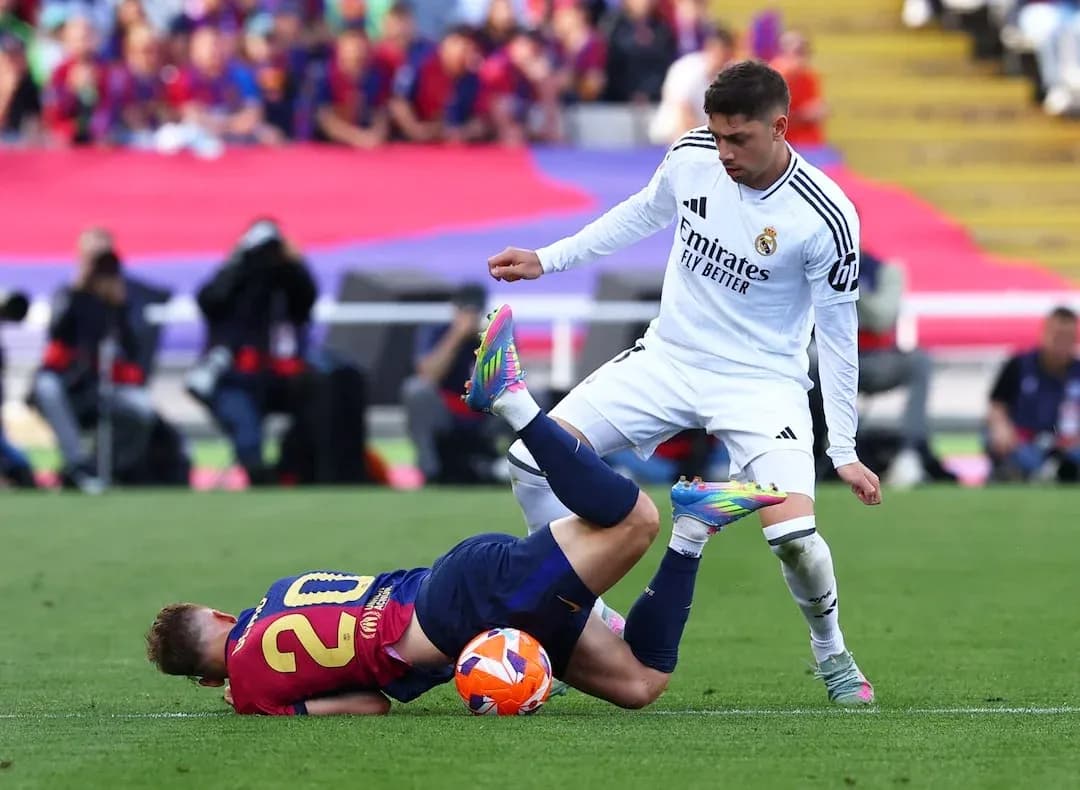
Barcelona's Tactical Mastery in 2-0 Victory Over Real Madrid
Barcelona’s 2-0 home win over Real Madrid at Camp Nou in La Liga’s Regular Season - 35 was built on an aggressive, front‑foot interpretation of Hansi Flick’s 4-2-3-1. Two early strikes from Marcus Rashford and Ferran Torres established a lead that Barcelona then managed through control of territory and possession rather than sheer shot volume. Alejandro Hernandez oversaw a contest in which Barcelona’s intensity without the ball and Real Madrid’s structural issues in buildup defined the tactical story more than the raw xG figures of 0.99 to 0.79.
I. Scoring Sequence & Disciplinary Log
Barcelona struck first on 9', when Marcus Rashford finished a move that typified Flick’s vertical approach from a 4-2-3-1: high positioning of the three attacking midfielders and an aggressive first line pinning Real Madrid’s back four. On 18', Ferran Torres doubled the lead, assisted by Dani Olmo, exploiting Madrid’s difficulty in tracking central runs from the “10” zone as Barcelona overloaded the half-spaces.
From there, the match shifted into a control phase for Barcelona, with Real Madrid chasing the game. The disciplinary pattern reflected Madrid’s struggles to contain transitions and Barcelona’s emotional edge in duels:
Disciplinary log (chronological, with reasons):
- 40' Eduardo Camavinga (Real Madrid) — Foul
- 52' Dani Olmo (Barcelona) — Argument
- 52' Raúl Asencio (Real Madrid) — Foul
- 55' Jude Bellingham (Real Madrid) — Unallowed field entering
- 81' Raphinha (Barcelona) — Argument
- 81' Trent Alexander-Arnold (Real Madrid) — Argument
Card totals, locked from events:
Barcelona: 2, Real Madrid: 4, Total: 6.
The halftime score was Barcelona 2-0 Real Madrid, reflecting Barcelona’s ruthless start. No further goals followed in the second half, despite Real Madrid adjusting personnel and pushing more men forward.
II. Tactical Breakdown & Personnel
Flick’s Barcelona lined up in a clear 4-2-3-1: Joan García in goal; a back four of João Cancelo, Gerard Martín, Pau Cubarsí, and Eric García; a double pivot of Pablo Gavi and Pedri; with Marcus Rashford, Dani Olmo, and Fermín López behind Ferran Torres. The structure was recognisable, but the interpretation was notably aggressive. The double pivot stepped high to compress space around Aurélien Tchouaméni and Eduardo Camavinga, while Rashford and Fermín López pinched into the half-spaces to create 4v3s against Madrid’s central block.
Out of possession, Barcelona’s 4-2-3-1 became a 4-4-2/4-2-2-2 press, with Rashford often jumping alongside Torres to press the centre-backs, while Olmo and Fermín López narrowed to block passes into Jude Bellingham. This forced Real Madrid wide, where Barcelona’s full-backs could engage aggressively, trusting Pau Cubarsí and Eric García to defend Gonzalo García and the depth runs of Vinicius Júnior in more isolated situations.
Real Madrid mirrored the 4-2-3-1 on paper under Alvaro Arbeloa: Thibaut Courtois in goal; Trent Alexander-Arnold, Raúl Asencio, Antonio Rüdiger, and Fran García in the back line; Camavinga and Tchouaméni as a double pivot; Brahim Díaz, Bellingham, and Vinicius Júnior behind Gonzalo García. In practice, though, Madrid’s structure was less cohesive. Alexander-Arnold’s advanced positioning in buildup left Asencio exposed to Rashford’s diagonal presses, and Tchouaméni was often pulled wide to cover, opening central lanes that Barcelona exploited for both early goals.
The key turning point in the game state came not from a specific event but from Flick’s in‑game management once 2-0 was secured. Substitutions were clearly oriented towards energy management and defensive consolidation rather than chasing further goals:
- 64' Frenkie de Jong (IN) came on for Dani Olmo (OUT)
- 64' Raphinha (IN) came on for Marcus Rashford (OUT)
- 70' Thiago Pitarch (IN) came on for Eduardo Camavinga (OUT)
- 77' Robert Lewandowski (IN) came on for Ferran Torres (OUT)
- 77' Marc Bernal (IN) came on for Gavi (OUT)
- 79' Franco Mastantuono (IN) came on for Brahim Díaz (OUT)
- 79' César Palacios (IN) came on for Gonzalo García (OUT)
- 88' Alejandro Balde (IN) came on for Fermín (OUT)
De Jong’s entry deepened Barcelona’s control of tempo, allowing Pedri to step higher and link more with Lewandowski. Raphinha provided vertical threat on the right but also tracked back diligently, though his 81' yellow for “Argument” underlined the emotional temperature of the contest. Balde’s late introduction for Fermín López effectively shifted Cancelo inside phases and locked down the left flank against Madrid’s late crossing barrage.
For Madrid, Pitarch’s introduction for Camavinga was a like-for-like in shape but signalled a tilt toward more progressive passing from deep. Mastantuono and Palacios added energy and dribbling threat between the lines, yet the structural issues in accessing Bellingham centrally persisted. With Barcelona’s block compact, Madrid’s 4-2-3-1 often devolved into sterile wing circulation and hopeful crosses, which Barcelona’s centre-backs and Joan García handled comfortably.
III. The Statistical Verdict
Barcelona’s dominance is best captured by the possession and shot quality profile rather than sheer volume. They finished with 57% possession and a pass profile of 527 passes, 484 accurate (92%), reflecting a high Overall Form in ball retention and circulation. Their 10 total shots, with 7 on goal and 9 from inside the box, translated into 0.99 xG, indicating that while they created good zones, the chances were controlled rather than chaotic. Joan García needed only 1 save, underscoring a strong Defensive Index: territorial control plus a compact block that limited Real Madrid to low‑impact efforts.
Real Madrid, with 43% possession and 394 passes, 342 accurate (87%), were less secure in buildup and more reliant on direct progression. Their 8 total shots (1 on goal) for 0.79 xG show that while they reached promising areas (7 shots inside the box), Barcelona’s pressure on the ball-carrier and box defending forced rushed or contested finishes. Courtois, with 5 saves, had to operate at a higher workload, reflecting Barcelona’s superior chance conversion into shots on target.
Discipline further underlined the game’s asymmetry: Barcelona’s 18 fouls and 2 yellow cards contrasted with Real Madrid’s 9 fouls and 4 yellows, including “Unallowed field entering” for Bellingham and multiple bookings for “Argument.” Barcelona accepted a higher foul count as the cost of aggressive pressing, while Madrid’s cards often came from frustration rather than tactical fouling. In sum, the data and structure align: Barcelona’s proactive 4-2-3-1 and in‑game management delivered a controlled 2-0, with Real Madrid’s mirrored shape unable to generate sustained, high‑quality threat.