.svg&w=384&q=75 "GoalGist logo")
Barcelona's Summer Rebuild: Addressing the Number Nine Dilemma
Barcelona’s summer rebuild has been bold, expensive and, in one crucial area, incomplete.
They have stacked the squad with talent in almost every line. They have not replaced the number nine.
A supercharged squad – with a hole down the middle
The headline arrival is Rodri from Manchester City, a Ballon d'Or winner and World Cup-winning captain parachuted into a midfield that was already dripping with quality. Hansi Flick now has a control room most coaches can only dream about.
Out wide, Barcelona have gone for raw speed and direct threat. Anthony Gordon brings Premier League intensity on the left, Karim Adeyemi offers chaos and penetration from either flank, and 18-year-old Belgian winger Jesse Bisiwu has been added as a long-term project rather than an immediate starter.
It all looks impressive on paper. Until you scan the team sheet and realise there is no recognised centre-forward.
Robert Lewandowski, the reference point of this attack for years, has gone. At 37, he chose a final adventure with Chicago Fire in Major League Soccer when his contract expired at the end of last season. Ferran Torres, who often deputised through the middle and delivered 21 goals in 49 appearances last term, has been sold to Paris St-Germain for about 50m euros (£42.7m).
Two senior forwards out. No senior striker in.
With the La Liga opener away to Elche on Sunday, 23 August, Barcelona are staring at the very real possibility of entering the season – and perhaps playing the whole campaign – without a conventional number nine if no deal is done before the window closes on 1 September.
The Alvarez obsession
Inside the club, there is no secret about Plan A: Julian Alvarez.
Barcelona have made the Atletico Madrid forward their preferred solution. The 26-year-old Argentina international publicly admitted during the World Cup that he would be looking for a move away, a comment that instantly alerted Europe’s elite and encouraged both Barcelona and Real Madrid.
Atletico’s response was immediate and uncompromising. Chief executive Miguel Angel Gil Marin insisted Alvarez would not be sold, “not even for 200m euros” (£170.8m). It was as much a message to their own supporters as it was to the market: hands off.
For Barcelona, it leaves an awkward reality. Their ideal target is effectively locked away unless something dramatic changes in the final days of the window.
Flick is under no illusions.
“We know we have to do something,” he said this month, acknowledging the gap and hinting that, for now, the answer may have to come from within.
Lamine Yamal and the false nine puzzle
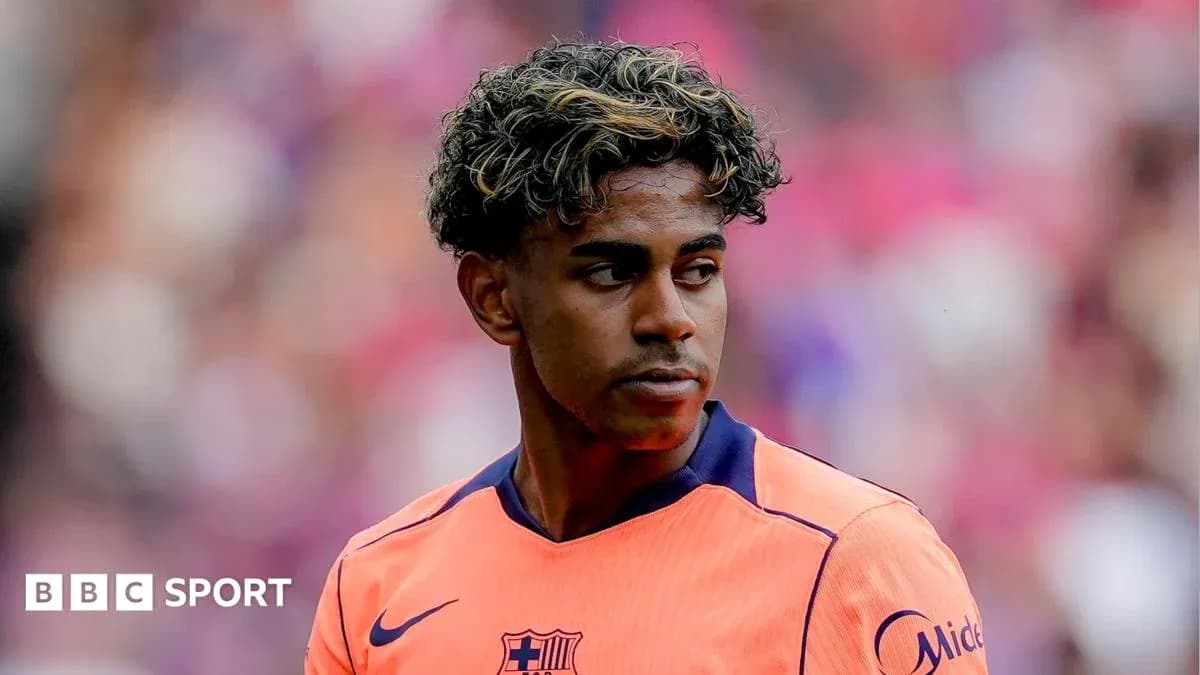
If Barcelona do turn inward, the first name on everyone’s lips is Lamine Yamal.
Still a teenager, he has already become the attacking focal point of this team and is coming off a season in which he scored 24 goals and lifted the World Cup with Spain. Those are absurd numbers and achievements for his age.
Yet his most devastating quality is not as a central poacher. It is his ability from the right wing to isolate a full-back, square them up, cut inside and conjure something from positions where most players would simply recycle the ball. That is where Flick sees his greatest value.
The German’s preference is clear: Lamine Yamal starting wide on the right, not chained to the centre-backs as a permanent false nine.
He can still drift inside and occupy central spaces, of course, and Flick has floated the idea of using him as a false nine when required. But that feels more like a tactical variant than a long-term solution.
Dani Olmo offers another option between the lines. The Spain international has the intelligence and movement to operate as a false nine, dropping into pockets, dragging defenders out and letting runners explode into the gaps. Raphinha has also been used centrally by Flick, while Fermin Lopez has publicly stated he is comfortable playing as a false nine too.
None of them, though, are natural penalty-box predators.
Speed, rotation… and a gamble?
Gordon and Adeyemi change the dynamic of Barcelona’s front line. Both thrive when they can run at defenders, attack space and turn a game into a sprint rather than a chess match. Their pace and direct running will stretch defences and open lanes for midfielders to arrive late.
What they do not provide is the classic number nine profile: back to goal, occupying centre-backs, living off half-chances in the six-yard box.
That leaves Flick with a clear tactical fork in the road. He can push hard for a specialist striker and reshape the attack around a focal point. Or he can lean fully into a fluid front line, with constant rotation, interchanging positions and no fixed reference in the middle.
On paper, that kind of movement could make Barcelona a nightmare to defend. Centre-backs would have no obvious mark, full-backs would be dragged inside, and midfielders would be forced into uncomfortable decisions all over the pitch.
It is also a risk. Across a long season, there are nights when a team needs the simplicity of a cross and a header, a scruffy rebound, a striker who scores with his only touch.
Barcelona, as it stands, do not have that player.
The club’s hierarchy know it. Flick knows it. The question now is whether they can prise Alvarez – or another specialist nine who fits the profile – out of their current club before 1 September, or whether one of Europe’s superpowers is about to bet an entire title defence on a team without a traditional centre-forward.