.svg&w=384&q=75 "GoalGist logo")
Ángel Di María's Support for Messi and Scaloni's Future
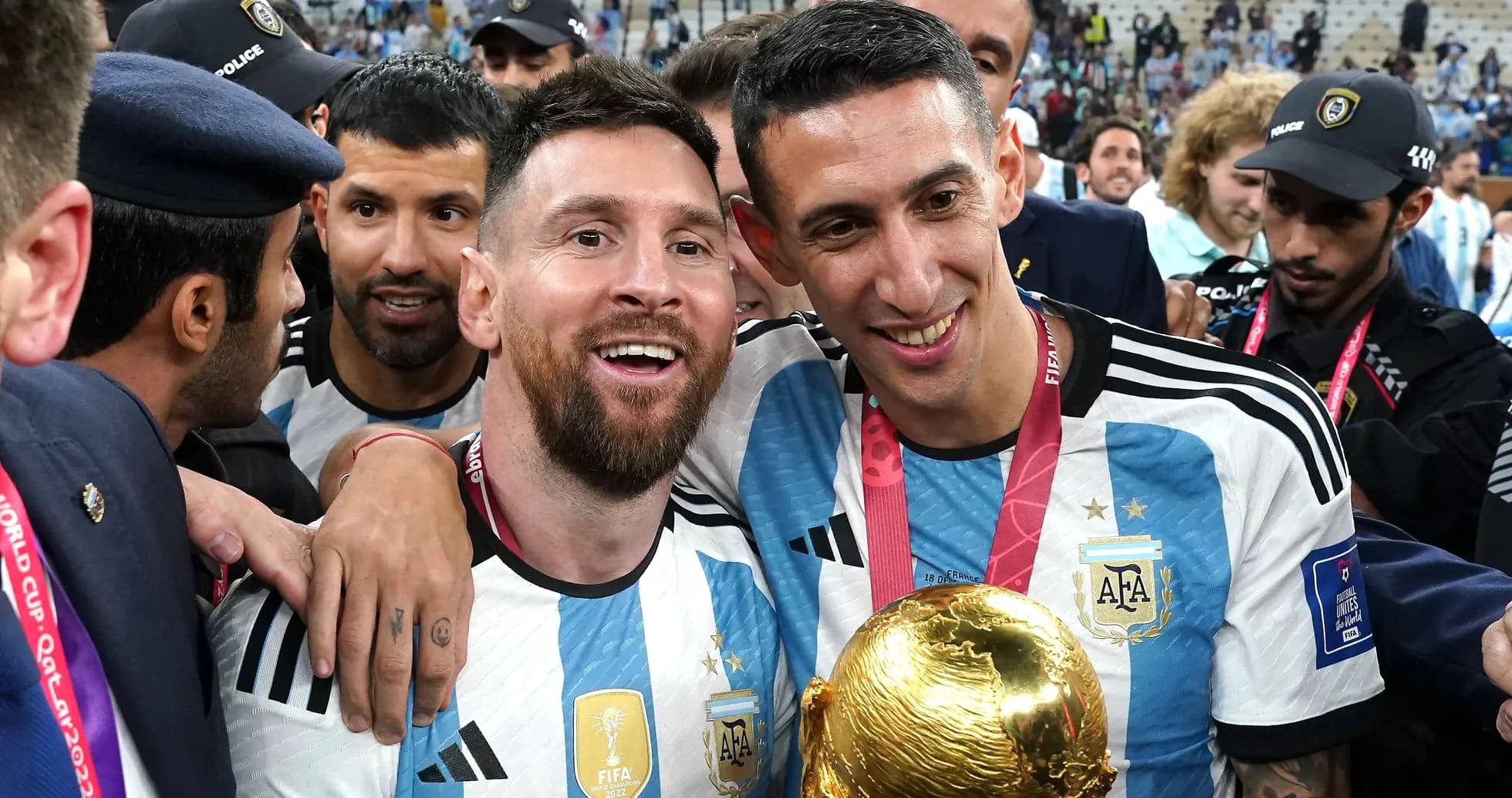
Ángel Di María stood in a mixed zone after a 2-1 defeat with Rosario Central, but his words were aimed far beyond Belgrano and the Argentine league. His message was for Lionel Messi — and for anyone who thinks the story is already written.
“Leo has to keep going as long as he wants,” Di María said, the line delivered with the certainty of someone who has seen Messi at his most human and his most otherworldly. Nearing 40, the eight-time Ballon d’Or winner has been nudged toward the exit by the calendar, by opponents, by the weight of history. Not by his teammates.
“I think he can continue for many more years. At 39, he's shown that he's one of the best and that he can continue to be one of the best in history. He has no ceiling, there's nothing more for him.”
In Argentina, those words land at a delicate moment. Leandro Paredes has already revealed that Messi treated the 2026 World Cup final as his farewell to the national team, a curtain call on a generation that dragged the Albiceleste from nearly-men to serial winners. For many, that was the closing chapter.
Di María isn’t ready to close the book.
To him, Messi remains the one who decides when the lights go out. The captain still dictates his own destiny, still bends games and narratives around his left foot. Age, in Di María’s view, is a detail — not a verdict.
Scaloni at the heart of a new era
Di María’s defence of Messi’s future quickly broadened into something larger: the future of the entire project. If Messi is the symbol, Lionel Scaloni is the architect.
“Scaloni is the leader of the national team, I hope he stays for everyone's sake,” Di María insisted. No dressing. No diplomacy. Just a clear statement about the man who has overseen a golden era.
Under Scaloni, Argentina have stacked trophies: the World Cup, two Copa Americas, the Finalissima. More than silverware, though, he has built a structure — a culture — that has allowed veterans to peak late and youngsters to arrive without fear.
“He's developing a good generation of young players who are coming through now, and every little bit helps. I hope he stays; it's his decision. Scaloni, better than anyone, knows what he wants, but obviously, as an Argentine, I'd like him to continue.”
It is rare for a player of Di María’s status to be so open about a coach’s importance. But this is a group that knows what life was like before stability, before continuity, before a clear identity. Scaloni, in their eyes, is not just a selector; he is the anchor holding together a squad in transition.
A generation that changed everything
The conversation inevitably drifted back to the journey. To the scars and the celebrations. To the sense that this group, whatever happens next, has already carved its place in football’s highest tier.
“They deserve more than just applause for everything they've achieved and have continued to achieve,” Di María said of his teammates. “Beating England was the culmination of all that. For me, the World Cup ended there, and we gave the country its greatest joy, and that's the most beautiful thing for everyone.”
That line says plenty. For Di María, the symbolic peak wasn’t just lifting a trophy; it was the emotional release of a defining victory, the sense that a nation’s long wait for catharsis had finally ended. The squad, he believes, has crossed from hopeful contenders into the pantheon.
They are no longer chasing validation. They have it.
Suffering, pride, and what comes next
Di María did not pretend the last World Cup was a smooth ride from anthem to final whistle. Far from it.
“I suffered through every match,” he admitted. Anyone who watched Argentina’s campaign would recognise that feeling — the tension, the narrow margins, the constant sense that one moment could tilt everything.
“But in the end they drew on their inner strength and that's what led to victories. Finals are finals; sometimes you win, sometimes you don't. This time it wasn't our turn, but I think the lads did the national team proud.”
There is no sugar-coating in that assessment. Argentina reached the summit in recent years; they also discovered how brutal football can be when it refuses to follow the script. Yet Di María’s verdict is firm: pride, not regret, should define this era.
His words leave Argentina at a crossroads framed by two men named Lionel. One, a captain who “has no ceiling” even as he stares down 40. The other, a coach who has turned chaos into continuity and now holds his own future in his hands.
If both stay, the golden era might not be over. If either walks away, the national team enters something entirely different.