.svg&w=384&q=75 "GoalGist logo")
Anderlecht's Tactical Turnaround Against Hammarby FF
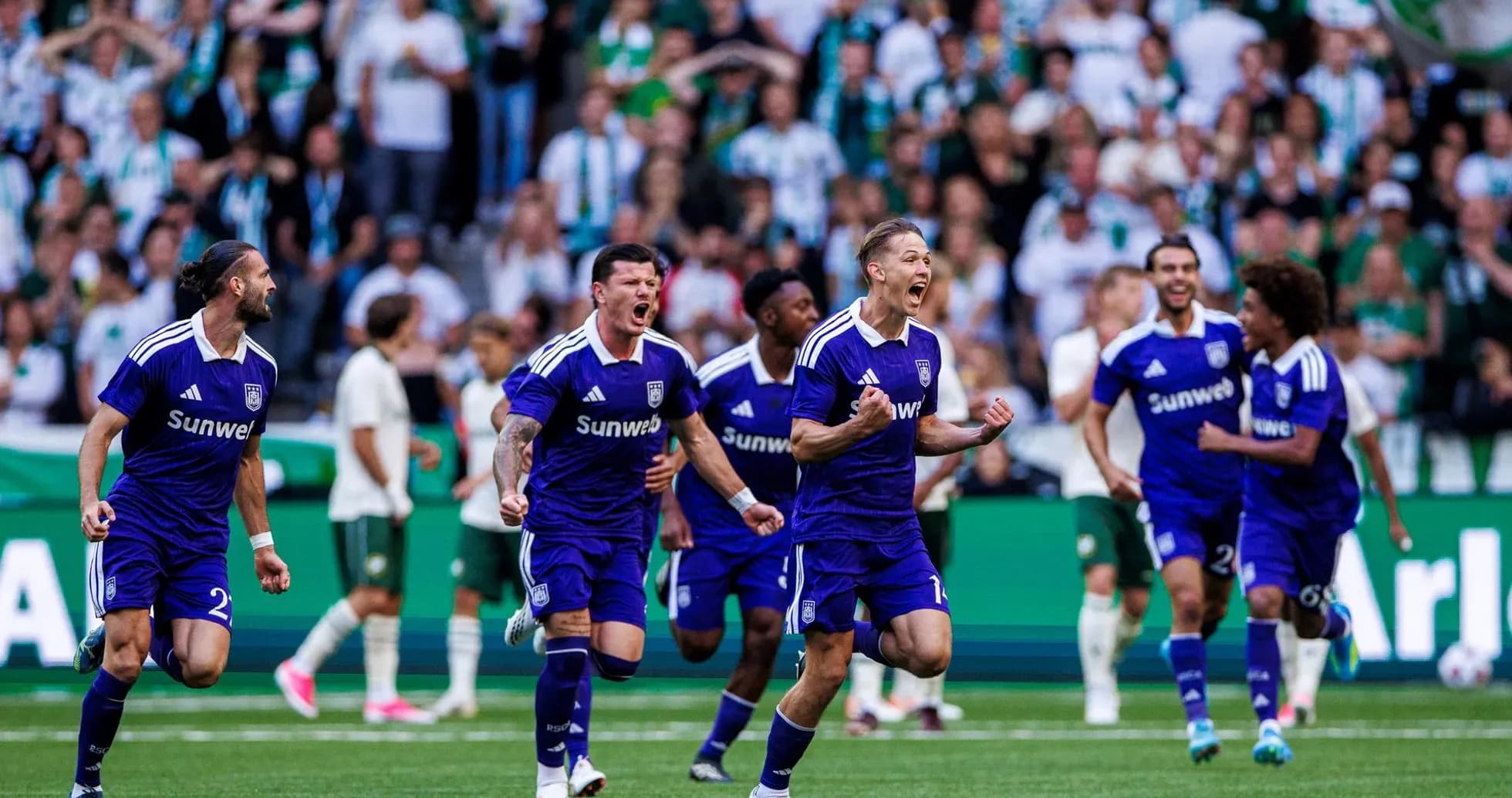
Anderlecht’s 3–1 turnaround against Hammarby FF at Lotto Park was built on structural tweaks, territorial dominance and a clear shift in duels and second balls after the break. From a 0–1 deficit at half-time to a commanding full-time score in this UEFA Europa League 2nd Qualifying Round tie, the match evolved from Hammarby’s early punch into a sustained Anderlecht siege that eventually broke the visitors’ compact 4-2-3-1.
First Half
Hammarby’s start was scripted around vertical efficiency. In their 4-2-3-1, with P. Abraham as the lone forward and V. Lind, O. Johansson and M. Madjed underneath, they struck immediately at 2' through Abraham. That early goal allowed Kalle Karlsson’s side to collapse into a low-to-mid block, protecting the central lane with the double pivot of T. Tekie and M. Karlsson. With only 6 total shots (3 on goal) and no corner kicks across 90 minutes, their plan was not to trade volume but to threaten selectively in transition and then defend deep.
Anderlecht, in Vitor Bruno’s 4-4-2, initially lacked the vertical aggression to destabilize that block. The back four of A. Maamar, L. Petrot, G. Biancone and L. Augustinsson provided width, but the first half pattern was more about sterile possession and crossing positions than true penetration. The front pairing of D. Sikan and J. Onia Seke often received with their backs to goal, and the wide midfielders K. Nga and L. Ambros were not yet attacking the half-spaces with enough aggression to force Hammarby’s back line to turn.
Second Half
The tactical hinge came at half-time. Anderlecht made a double change at 46', with M. N’Diaye (IN) for L. Augustinsson (OUT) and M. Cvetkovic (IN) for K. Nga (OUT). Functionally, this rebalanced the side. N’Diaye shored up the left defensive channel, allowing the remaining full-backs to be more assertive, while Cvetkovic added directness and a stronger presence between the lines. Immediately, the impact was visible: at 47', D. Sikan finished a move assisted by A. Maamar, the right-back advancing high and delivering from a more aggressive position. The 1–1 equaliser signalled a clear shift—Anderlecht’s full-backs were now key attacking outlets, and the second line was stepping higher to pin Hammarby back.
From there, the statistical pattern tells the tactical story. Anderlecht finished with 21 total shots to Hammarby’s 6, including 6 on goal versus 3. The hosts also earned 10 corner kicks while Hammarby had none, an indicator of sustained pressure and territorial occupation of the final third. This wasn’t random volume; it was the product of a structurally higher block, with E. Llansana and M. Kana anchoring midfield and allowing Ambros and the substitutes ahead of them to commit bodies into the box.
Hammarby’s defensive approach became increasingly reactive. With no corner kicks and just 3 shots off goal, their attacking phases dwindled as the match progressed. Substitutions at 66'—A. Boudri (IN) for P. Abraham (OUT) and N. Besara (IN) for M. Madjed (OUT)—were aimed at freshening the attacking midfield and centre-forward roles, but they did not change the underlying dynamic: the team continued to defend deep, struggling to exit under Anderlecht’s pressure. Later changes, including I. Fofana (IN) for V. Lind at 76' and E. Kabore (IN) for O. Johansson at 76', further reshaped the front line, but without improving ball retention or counter-attacking threat.
The decisive phase arrived in the final quarter-hour, where Anderlecht’s superior shot volume finally translated into scoreboard control. At 81', Cvetkovic, already booked at 65' for “Roughing”, crowned his influential cameo with a goal for 2–1, reflecting his dual role as both aggressive presser and late-arriving finisher. The substitution of Sikan for T. Degreef at 84' added fresh legs up front, and Degreef himself struck at 89' for 3–1, underscoring the depth and attacking rotation available to Vitor Bruno. The late change at 90+2', with Z. Keita (IN) for L. Ambros (OUT), was about game management and shoring up the flank as Anderlecht protected their lead.
Discipline Patterns
Discipline patterns also matched the tactical flow. Hammarby collected 3 yellow cards (P. Abraham at 27' for “Foul”, V. Eriksson at 55' for “Handling”, M. Karlsson at 73' for “Holding”), reflecting a side repeatedly forced into emergency or cynical interventions as they tried to slow Anderlecht’s momentum. Anderlecht’s 2 yellows—Cvetkovic for “Roughing” at 65' and J. Onia Seke for “Unsportsmanlike conduct” at 66'—came in the midst of their high-intensity push, by-products of an aggressive, front-foot posture.
Goalkeeping Performance
In goal, C. Coosemans (Anderlecht) faced a relatively light workload, making 2 saves as his side controlled territory and limited Hammarby’s shot count. At the other end, W. Hahn (Hammarby FF) registered 3 saves, but with Anderlecht firing 6 shots on goal, the hosts were consistently testing him and forcing defensive interventions around the box, as reflected in Hammarby’s inability to generate corners or sustained pressure of their own.
Conclusion
Without possession or passing percentages, the best proxies for control are shot volume, corners and foul distribution. Anderlecht’s 21–6 shot advantage and 10–0 corner count point to a match where, after the early shock, they imposed their structure and tempo. Hammarby’s 10 fouls to Anderlecht’s 12 suggest a competitive duel count, but the location of those fouls—often in their own half, as implied by their card reasons and defensive posture—favoured the hosts’ set-piece and crossing game.
Overall, the tactical arc is clear: Hammarby’s early lead and compact 4-2-3-1 were gradually overwhelmed by Anderlecht’s half-time adjustments, more aggressive full-back play, and a deep bench that delivered both intensity and goals. The 3–1 final score at Lotto Park accurately reflects a contest where Anderlecht turned structural superiority and territorial dominance into a decisive second-half performance.