.svg&w=384&q=75 "GoalGist logo")
Anderlecht Dominates Kairat Almaty in 3–0 Victory
The 3–0 scoreline for Anderlecht at Central Stadium was the logical expression of a game they controlled territorially and structurally from the opening minutes, against a Kairat Almaty side whose 4-4-1-1 collapsed once reduced to ten men. With 67% possession and an 8–2 advantage in corner kicks, Anderlecht’s 4-3-3 imposed the rhythm, pinned Kairat back, and forced the home team into long, low-percentage phases without the ball.
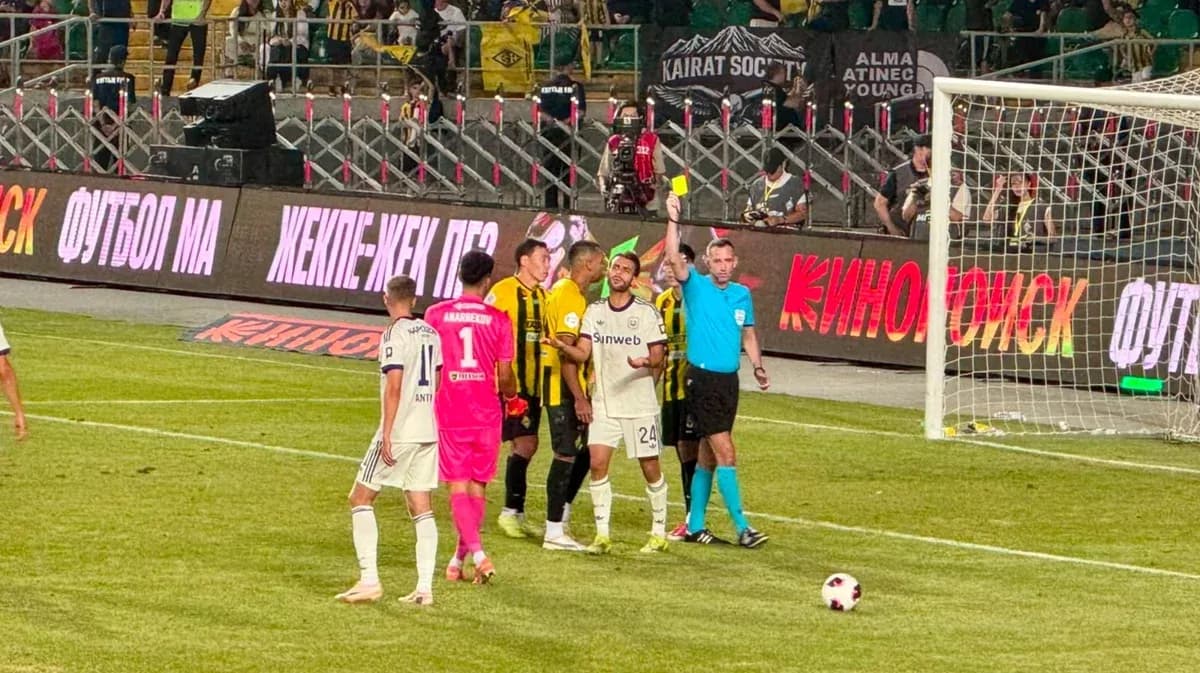
Kairat’s nominal 4-4-1-1, with Edmilson as the highest reference and M. Gual just off him, never really functioned as a platform for sustained attacks. The back four of L. Mata, Lucas Africo, A. Shirobokov and E. Tapalov was protected by a flat midfield line including J. Oksanen and O. Jukkola, but the unit was stretched early. The decisive tactical blow came on two fronts: an own goal that immediately undermined Kairat’s game plan, and then the 39th-minute red card for Aleksandr Shirobokov, which destroyed their defensive balance.
First Half
The second-minute own goal from J. Oksanen, under Anderlecht pressure, instantly flipped the match context. Kairat, set up to be compact and counter, were forced to chase the game without the ball. Anderlecht’s front three of M. Cvetkovic, D. Sikan and J. Nga Kana, supported by the midfield triangle of L. Ambros, E. Llansana and M. Kana, could now circulate possession patiently, using the full width provided by full-backs L. Augustinsson and A. Maamar. The 67% possession figure is the clearest statistical expression of this structural superiority.
Anderlecht’s 4-3-3 was also more aggressive and layered in the final third. They produced 4 shots on goal to Kairat’s 2, but the more telling figure is the blocked shots count: Anderlecht had 5 shots blocked, indicating repeated entries into Kairat’s box and a home defence forced into emergency interventions. L. Ambros’ goal at 24 minutes, making it 2–0, illustrated the midfield’s ability to arrive from deeper positions; Kairat’s midfield line was pinned back by Anderlecht’s circulation and could not track the late run.
After the red card for Shirobokov at 39 minutes, Kairat’s 4-4-1-1 effectively became a 4-4-1 without the possibility of holding a high line. The defensive block retreated even further, but with one centre-back gone, the remaining trio and the nearest midfielder were constantly forced to compress the central lane, leaving more space in wide areas for Anderlecht’s full-backs. The third goal at 45 minutes, scored by D. Sikan and assisted by L. Ambros, was the direct consequence of this numerical and positional overload: Anderlecht could circulate until a gap opened in Kairat’s reshuffled back line.
Second Half
The second half became an exercise in game management for Anderlecht. Vitor Bruno used his substitutions to refresh wide and midfield zones without altering the fundamental 4-3-3 structure. T. Degreef (IN) came on for M. Cvetkovic (OUT) at 46', O. Antman (IN) for J. Nga Kana (OUT) at 63', M. Winkler (IN) for A. Maamar (OUT) at 74', N. Ojea (IN) for E. Llansana (OUT) at 84', and A. Bertaccini (IN) for D. Sikan (OUT) also at 84'. Each change preserved the three-line spacing: a stable back four, a compact midfield trio, and a rotating front three that continued to press and recycle possession.
Rafael Urazbakhtin’s response was necessarily reactive and largely defensive. At 46', O. Baybek (IN) came on for A. Mrynskiy (OUT), a move that looked aimed at reinforcing midfield legs and stabilising the flanks. On 60 minutes, A. Tuyakbaev (IN) replaced M. Gual (OUT) and I. Bekbolat (IN) replaced Edmilson (OUT), effectively refreshing the front line but without changing the underlying 4-4-1 structure; Kairat still lacked numbers and platforms to build through the thirds. Later, at 72', L. Kurgin (IN) came on for L. Mata (OUT) and A. Sadybekov (IN) for J. Oksanen (OUT), further underlining the priority: contain damage, re-balance the back four, and add energy centrally rather than chase an unlikely comeback.
Disciplinary Pattern
The disciplinary pattern reflects the tactical stress points. Anderlecht, despite dominating the ball, committed 17 fouls to Kairat’s 11 and picked up 4 yellow cards, suggesting an aggressive counter-press and a high defensive line willing to risk contact to prevent transitions. Kairat, by contrast, had 1 yellow and 1 red card; the sending-off of Shirobokov was the pivotal defensive event of the match, forcing a structural reorganisation that Kairat never solved.
From a territorial and set-piece standpoint, Anderlecht’s 8 corner kicks to Kairat’s 2 show how consistently they locked Kairat in their defensive third. Kairat’s 33% possession and limited shooting volume (2 shots on goal, 2 off, plus 1 blocked) underline that their attacks were sporadic and largely individual rather than the product of sustained, collective patterns. Without reliable passing data, the dominance is still evident: Anderlecht not only had more of the ball but used it to repeatedly enter dangerous zones, forcing blocks and corners.
In summary, the match was defined tactically by Anderlecht’s stable, ball-dominant 4-3-3 and Kairat’s inability to adapt their 4-4-1-1 once they went behind early and then lost a centre-back. The possession share, corner count and blocked-shot profile all point to a visiting side that controlled territory and tempo, while the red card and Kairat’s low attacking output explain why the home team never found a route back into the tie.