.svg&w=384&q=75 "GoalGist logo")
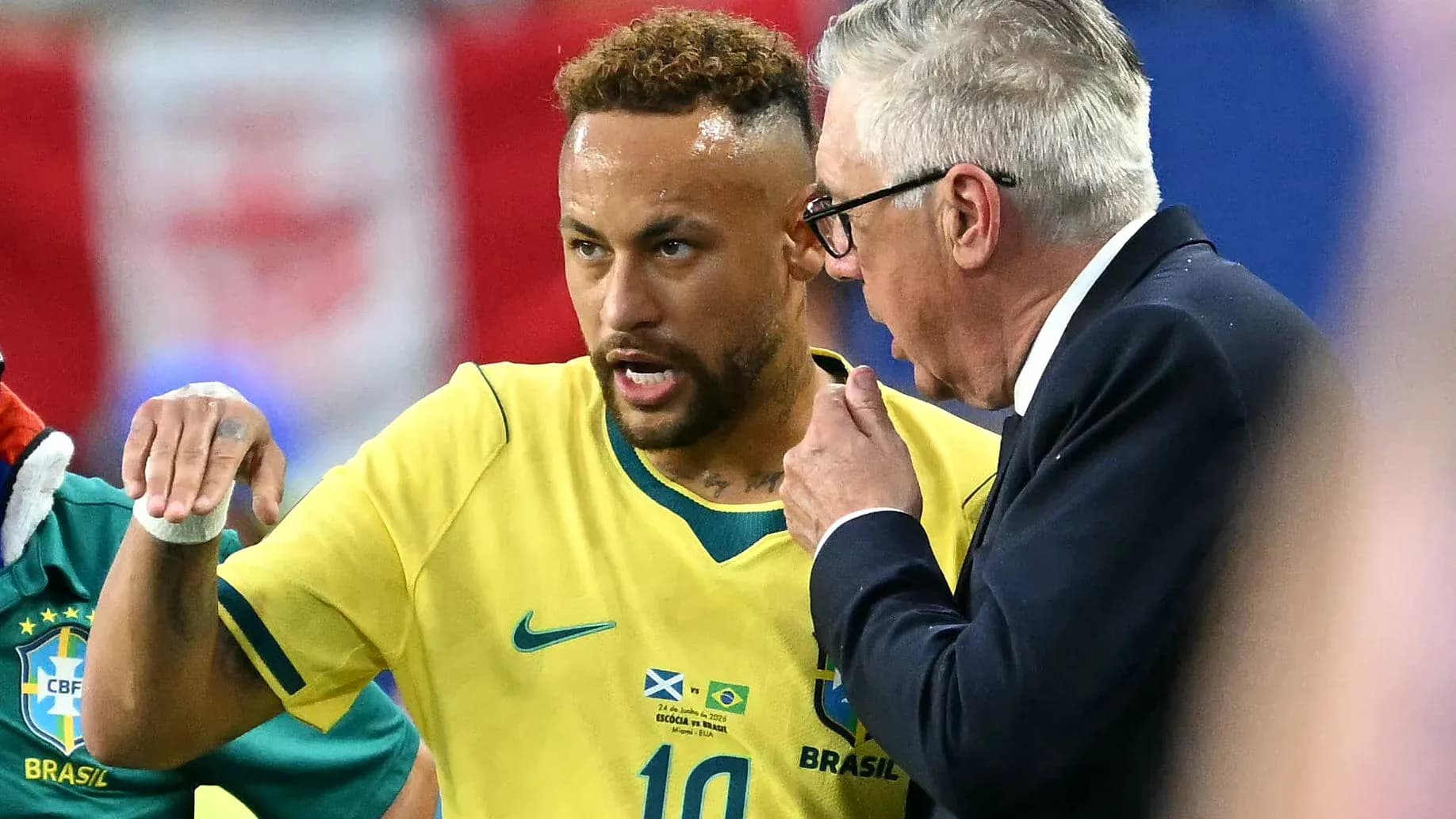
Carlo Ancelotti Addresses Neymar's Impact on Brazil's Future
Carlo Ancelotti has never been afraid of hard truths. This time, one of them is about Neymar.
The Italian coach, speaking after Brazil’s campaign, laid bare the tension between Neymar’s attitude and his condition. The will was there. The legs were not.
Neymar arrived at the tournament carrying a grade 2 calf strain, a problem serious enough to rule him out of the opening group games against Morocco and Haiti. Match fitness never really caught up with the calendar. By the time he was available, the competition had already taken shape without him.
“I think he didn’t contribute on a technical level as it was hoped he could, because he couldn’t,” Ancelotti told ESPN. The key word there: couldn’t, not wouldn’t.
Behind closed doors, it was a different story. Ancelotti praised Neymar’s leadership, his presence in the dressing room, his willingness to stay engaged despite his limitations. “In terms of attitude, it was a very positive attitude. I have a lot of affection for him, I thanked him for his attitude, for his behavior, and I think it was the right decision to include him on the 26-man roster.”
The respect is clear. So is the frustration.
“The only thing that bothered me is that Neymar could have prepared himself better during that lead-up period,” Ancelotti added. “He could have been ready for game one instead of game four. That was the only disappointing part.”
For a player who has long carried the number 10 shirt like a second skin, it feels like a closing chapter. Neymar has already signalled his international farewell, and Ancelotti is treating it as the start of something bigger than one man stepping aside.
This is not just the end of a cycle. It is a reset.
With his talisman out of the picture, Ancelotti is openly talking about a total rebuild as Brazil aim toward the 2030 World Cup. The idea is not simply to replace names, but to change the very spine of the project: less dependency on the icons who defined the 2010s, more responsibility on the next wave.
“I think that players like Neymar, who already commented yesterday, and with all due respect to his decision. I believe that in history, one generation ends and another has to come, and it has to be better than the last one,” the former Real Madrid boss said.
That line is not just about Neymar. It is about an entire dressing room that has carried Brazil through multiple tournaments, with all the scars and silver medals to show for it.
Ancelotti did not dodge the question when the futures of Casemiro, Danilo, and Alex Sandro came up. These are not fringe names. They are pillars of the last decade.
“I think so. It is a period that is coming to an end,” he admitted. There was no attempt to sugarcoat it, only a nod to what they have given. “Obviously, we have to thank all of them, and I have a lot of affection for all of them. But I think the idea that a player over 30 is done means that we have to think about the future.... Some of these players will be there, obviously. Marquinhos, for example. Alisson, we’ll see.”
That’s the balance Ancelotti is trying to strike: respect without sentimentality. Gratitude without paralysis.
Marquinhos is singled out as a survivor of the coming overhaul, a bridge between eras. Alisson’s role is left deliberately open, a reminder that even established stars must now prove they fit the next blueprint, not just the last one.
In Brazil, generational change is never just a tactical issue. It is cultural, emotional, almost spiritual. Letting go of Neymar and his contemporaries means more than changing a team sheet; it means accepting that the team of memory is no longer the team of destiny.
Ancelotti has drawn the line. The question now is not whether a new Brazil is coming.
It’s how quickly it can grow up.

