.svg&w=384&q=75 "GoalGist logo")
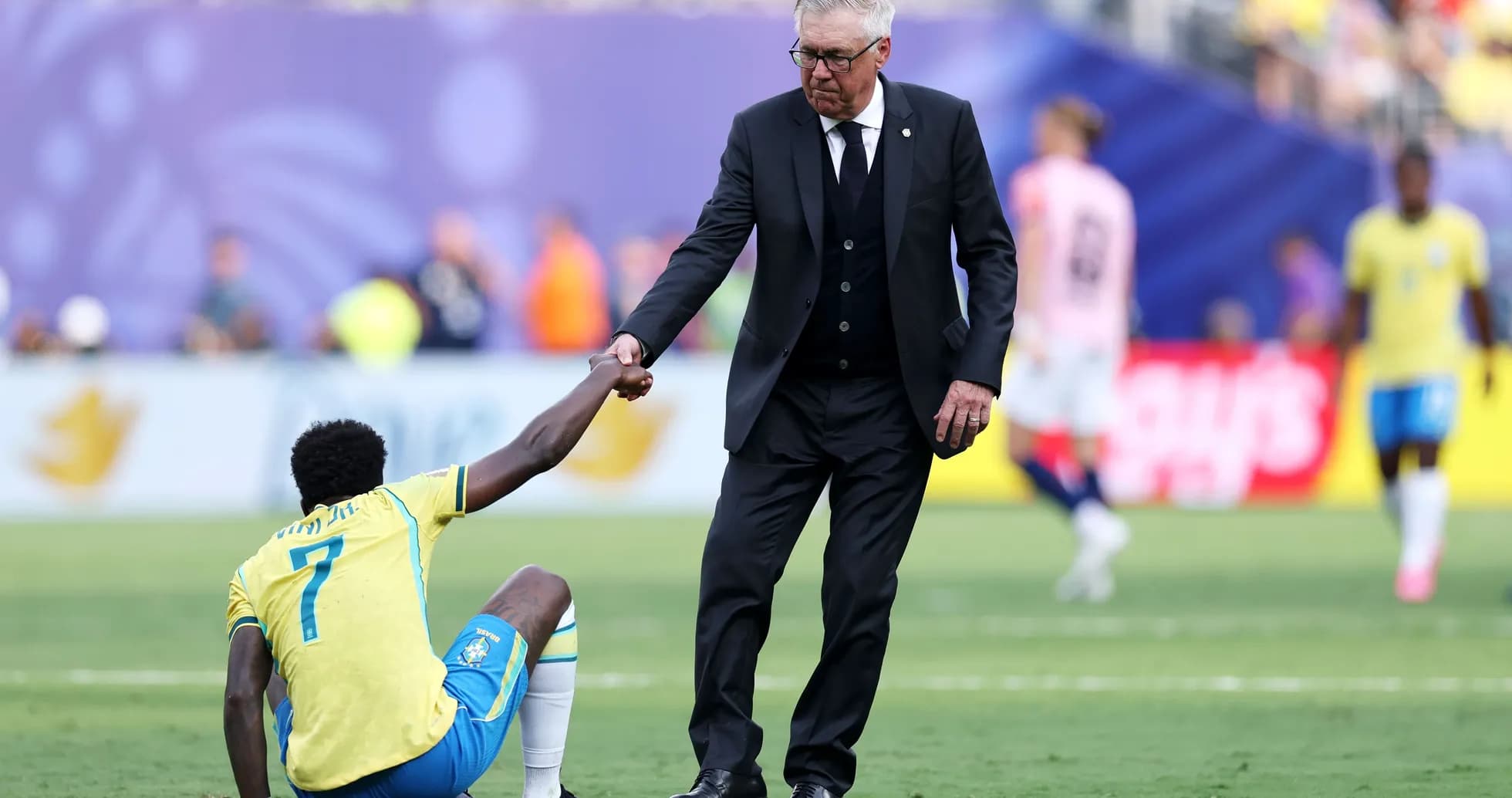
Carlo Ancelotti Reflects on Brazil's World Cup Exit
Carlo Ancelotti has lived enough nights in football to know that tournaments rarely hinge on a single moment. Yet when he looks back at Brazil’s 2026 World Cup exit, he keeps returning to one: a water break in the second half against Norway.
Brazil went out in the round of 16, beaten 2-1, their wait for a world title now stretching back to 2002. For Ancelotti, the turning point was not a thunderbolt from distance or a defensive collapse. It was a pause.
“We lost the World Cup during the water break”
Up to that point, Ancelotti insists, Brazil were managing the game.
“The team was in control of the flow of the match until that moment,” he reflected in an interview with ESPN. The cooling break came, the rhythm shifted, and so did his reading of the contest. Convinced Norway had wrestled back control, he reacted. He changed.
Perhaps, he now concedes, he misread it.
“Perhaps my mistake was here, when I thought the team had lost control of the match when that was not the case,” he said. The alterations unsettled Brazil just as Norway’s belief grew. Then came the blow that has haunted so many defences over the past decade: Erling Haaland.
Ancelotti did not dress it up. “We had the problem of Erling Haaland’s goal. And in the World Cup, when they score a goal against you in the thirtieth minute of the second half, it is very difficult to recover. But we did have a chance to recover.”
Norway had not exactly overwhelmed Brazil. They had the ball, yes, often deep in their own half, recycling, waiting. Ancelotti pointed out they had done something similar against England: “They controlled the match, but in the end, they could have beaten England.” Against Brazil, they did not let that chance slip.
Injuries and a shifting plan
Ancelotti’s reflection on the campaign is not one of chaos or disorganisation. On the contrary, he defended the broader work of his staff and players.
“In general, I think the work done over a year was excellent,” he said. “Logistically, the Brazilian team was very well organised in terms of the hotel, the stadium and the training ground. I think the players’ performance throughout the year was positive. I also think the 26 players who were called up were the most suitable to be there.”
The plan, though, did not survive intact. Injuries bit hard in the months leading up to the tournament and during it. “The plan drawn up last year changed slightly because of injuries, because we suffered many injuries in the period between March and the World Cup,” he explained.
He listed them: Militão, Rodrygo, Estêvão, Wesley before the World Cup, Raphinha during it. Each absence forced a tweak, a compromise, another layer of improvisation in a team still being shaped.
The Italian’s tone was not one of excuses, but of context. The structure remained, the ideas remained, but the personnel shifted. And in the knockout rounds, the margins for error narrowed to almost nothing.
Neymar, the timing, and the storm of criticism
If the water break was one flashpoint, the introduction of Neymar was the other. Ancelotti’s decision to bring on the veteran star in the final stages drew fierce criticism, accused of “upsetting the balance” of a team still fighting to turn the tie.
He rejects that notion.
No, when Neymar came on at that moment, I took off Ryan and brought on Endrick as a right winger, thinking that Neymar was capable of creating a goal, or showing his skills at that moment, in the 70th minute,” he said. This was not a sentimental change. It was a calculated gamble on a player who, in Ancelotti’s mind, remained decisive.
“That is what I intended to do against Japan,” he added, lifting the curtain on his broader knockout strategy.
Against Japan, the thinking had been different because the game state was different. “The team was completely in control of the match. Japan relied only on counter-attacks. The aim was not to score a goal, rather I was thinking of bringing on Neymar in extra time against Japan.”
Control there, chaos here. Same player, different timing.
Against Norway, he admits he accelerated the plan. “I brought Neymar on a little early to regain control of the match,” he said. The decision came in that tense, fractured period after the water break, when instinct and experience collide under the weight of a World Cup elimination game.
He knows how exposed a coach is in those minutes. He referenced Thomas Tuchel, another manager who has spoken openly about the intensity of such calls. “You have to make a very difficult decision. It is a moment full of tension, and you do not always get it right.”
No regrets over Neymar
For all the noise around Neymar’s introduction, Ancelotti stands firm on one point: the forward deserved to be on the pitch.
“I think Neymar should have been brought on, he had to come on at that moment because he was performing well, trained well, and prepared well. I liked his sporting spirit. I think he helped the team.”
The regret, if there is one, lies not in the player, but in the structural adjustment that followed. “With him coming on, there was no need to change the structure of the team,” he admitted. The attempt to regain control, combined with tactical reshuffling, left Brazil exposed at the worst possible time.
For a coach with Ancelotti’s record, such public self-critique is rare and revealing. He still believes in the year-long project, in the squad he chose, in the preparation. He still believes Neymar was the right card to play.
But in his mind, Brazil’s World Cup slipped away in the kind of detail that separates champions from contenders: a short pause for water, a misread of the game’s pulse, and a chain of decisions that ended with Haaland celebrating and Brazil packing their bags.
The next time Ancelotti stands on a World Cup touchline, how quickly will he move during the next break in play?